Judge Dismisses Lawsuit – Hazard Pay Prevails

UFCW 21
For immediate release: 3.18.2021,  12:35 PM
Contact: Tom Geiger, 206-604-3421 ( c )

In an effort to provide some compensation for the hard work and sacrifice of grocery store workers during the current health crisis of COVID 19, Seattle passed a hazard pay ordinance that went into effect on February 3rd. The industry quickly filed a lawsuit attempting to reverse this new law. Today the judge ruled against the industry. The city’s hazard pay law will remain in place.

Faye Guenther, President of UFCW 21 stated in response to the judge's decision:

“We have pushed for hazard pay for essential grocery store workers since May when the corporations running the stores decided, without even giving a reason, to cut the hazard pay that had been in place. The city’s hazard pay ordinance is a good law that provides temporary additional pay to the frontline workers in our grocery stores who have been putting their health and safety on the line every day since the pandemic began. The pay provides some additional income for these workers as their jobs have increased risk, increased demands, and increased hazards. And these workers’ labor is what has allowed the rest of the us in the community to get access to the food and other necessities we need and has resulted in the huge increased profits for the grocery store corporations.”

“This is a big win for grocery store workers who deserves this hazard pay and also a big win for all the other municipalities out there considering passing their own hazard pay ordinance that these laws are legal and will withstand the bullying lawsuits of the industry.”

American Rescue Plan: How It Benefits Essential Workers

On Thursday, March 11, President Joe Biden signed the COVID relief bill into law. This will provide millions of workers and families with the urgent relief they need as the COVID-19 pandemic continues. 

“In grocery stores and meatpacking plants across the country, millions of essential workers are on the frontlines as they face the daily threat of COVID infection to protect our food supply during this crisis. With the American Rescue Plan, these brave frontline workers will receive the support they have earned as they continue to put their own health at risk so that our families can put food on the table.” -UFCW President Marc Perrone

What’s in the American Rescue Plan for UFCW Members:

  • Relief Payments: Provides $1,400 in relief payments per person for individuals making less than $75,000 and married couples making less than $150,000. along with additional tax relief for working families with children. 

  • Childcare: Includes $15 billion for the Child Care and Development Block Grant and allows those funds to be used by essential workers. 

  • COVID Testing and Vaccine: Provides funding towards testing, contact tracing, PPE, and vaccine distribution.

  • Health and safety: Provides $200 million for pandemic-related worker protection activities at the Labor Department, half of which would go to the Occupational Safety and Health Administration (OSHA) to support OSHA enforcement and worker training in high-risk sectors such as meat processing, health care, correctional facilities and agriculture.

  • Extends unemployment benefits: Extends pandemic-related unemployment assistance that was set to expire on March 14, including the current $300 supplement to unemployment benefits, for another six months through Sept. 6. Provides that the first $10,200 of unemployment benefits received by taxpayers making less than $150,000 will not be subject to federal taxation.

  • Retirement Security: Strengthens the entire pension system by helping pension plans that are in danger of failing.

King County passes $4 Hazard Pay for Grocery Store Workers

This afternoon the King County Council voted 8-1 to pass a $4/hour Essential Grocery Store Worker Hazard Pay measure. This ordinance will cover large grocery stores in unincorporated King County, which are stores that are usually left out of city-level ordinances like those passed in Seattle and Burien. Grocery store workers at locations in unincorporated King County will now earn an extra $4/hour until the end of the county’s COVID state of emergency.

Watching this ordinance pass today made me really emotional,” said Jeannette Randall, UFCW 21 executive board member and shop steward at the Roxbury Safeway, a store that would be covered by this ordinance. “This vote and passing of this ordinance shows that local government can help improve the lives of workers. This legislation passing shows that King County Council cares about the vital service grocery workers provide for our community."

Grocery store workers in unincorporated areas in King County organized to let the county council know what it’s been like to work on the front lines of the pandemic, maintaining our community’s access to food throughout this global crisis. Workers contacted council members and spoke out in public comment at council meetings, sharing stories of their own and their family members’ illnesses, the fear of showing up to work when it doesn’t feel safe, and the courage it has taken to face a constant risk of exposure just to keep our neighbors and families fed and supplied.

Grocery stores have made profits not just during the COVID pandemic, but because of it, as people’s shopping habits were forced to change while schools, restaurants, and many workplaces were shut down or limited. Today, King County Council Members like Rod Dembowski, who sponsored this ordinance, and Dave Upthegrove, who co-sponsored it, along with King County Executive Dow Constantine, have shown their support for the county’s essential grocery store workers.

Contact us for more information
Need a Union? Text an organizer

Grocery Workers’ Voices at King County Council:

“It’s been so hard watching my dad’s health decline after contracting COVID-19. The hardest part is knowing I might be the one that exposed him to this disease because of my constant contact with people at work.” -Marcie Griffin, Roxbury Safeway


“I have severe lung damage due to COVID-19 and had to spend months on an inhaler to help with the symptoms. My daughter still coughs profusely and sounds like she’s been smoking for years. These are some of the impacts this pandemic has had on my family.” -Tiffany Melligan, Roxbury Safeway


“We all need help right now. We are barely making it on the wage we are given, and we need help to support our families where most of our children are not in school. We need the support of our companies.” -Lindsay Young, Kent Fred Meyer


Contact your councilmembers!

Voted in Favor:

  • Rod Dembowski: 206-477-1001, rod.dembowski@kingcounty.gov

  • Girmay Zahilay: 206-477-1002, girmay.zahilay@kingcounty.gov

  • Kathy Lambert: 206-477-1003, kathy.lambert@kingcounty.gov

  • Jeanne Kohl-Welles: 206-477-1004, jeanne.kohl-welles@kingcounty.gov

  • Dave Upthegrove: 206-477-1005, dave.upthegrove@kingcounty.gov

  • Claudia Balducci: 206-477-1006, claudia.balducci@kingcounty.gov

  • Pete von Reichbauer: 206-477-1007, pete.vonreichbauer@kingcounty.gov

  • Joe McDermott: 206-477-1008, joe.mcdermott@kingcounty.gov

Voted Against:

  • Reagan Dunn: 206-477-1009, reagan.dunn@kingcounty.gov

PCC Worker Candidates Qualify for the Ballot!

A huge thanks to everyone that signed petitions in November and December to put Donna Rasumussen and Laurae McIntyre on the ballot for the PCC Board of Trustees elections! We have received official verification of those signatures from PCC, which means that workers will be on the ballot for the first time in decades.

Voting will be April 8-May 3; PCC will send ballots via email. To be considered an active member who is eligible to vote, you must meet the following requirements by today, March 4, 2021:

  • Your membership is paid in full.

  • You have purchased merchandise, cooking classes or gift cards using your PCC membership since March 5, 2020.

To learn whether you are currently an active member, log into your PCC website account and click “Membership.”


Learn more about Donna and Laurae:

Learn about Donna
Learn About Laurae

Help nominate PCC worker, Laurae McIntyre, to the PCC Board of Trustees!

Learn more about worker candidate, Laurae McIntyre, and what she stands for:

Laurae.jpg

Laurae

I’ve been a member of PCC since the 1980s, and I have family whose porches used to be part of the co-op’s original network of drop-off spots in the ’50s! I came to work at PCC about 6 years ago, wanting to work somewhere that aligns with my values and where I get to interact directly with a lot of people in my community. Our role has only become more important now, during the COVID pandemic. For lots of people, coming to the grocery store is one of their only opportunities for community and connection, along with healthy food. I’ve been really humbled by this experience and the appreciation our customers have shared with us.

PCC is a community. People become members because of what we stand for. We support local producers instead of corporate ones, our food is clean and handled properly from its beginning to the store shelves. People work here because of what we stand for, too. As a union shop steward in my store, I get to welcome new people to our staff. We have a young and vibrant workforce that is pushing us to step up on racial equity, LGBTQ inclusion, and justice for workers all along the food supply chain—including the workers in our own stores.

I want to make sure my coworkers are represented on the Board of Trustees.

PCC has been expanding so fast recently, focusing on opening new stores and big remodels. That’s great, I’m happy for us to grow. But given that the people who are usually on the Board of Trustees are business focused, some with no retail experience whatsoever, PCC workers agree we need some representation on the Board. We’re the ones working in these stores day in and day out. We want to protect the core mission of the co-op, the reasons why we work here, and why our members shop here.

With a worker voice on the Board, the decisions that steer the future of our co-op can be informed by the people interacting one-on-one with our customers and working with the beautiful food our farmers provide. We’re ready to have a voice in shaping the values and direction of this community.

Help nominate PCC worker, Donna Rasmussen, to the PCC Board of Trustees!

Learn more about worker candidate, Donna Rasmussen, and what she stands for:

Donna.jpg

Donna

I’m a working mom, and my whole family is invested in the mission and success of PCC—in fact, my partner and two teenage sons all work for the co-op. In my 40 years of customer service, I think PCC has hands-down the best customers I’ve ever worked with.

As PCC focuses on its growth, many of my coworkers and I feel it’s time to again have a worker voice on the Board of Trustees to ensure that customers, workers, and our community are kept front and center in decision-making. Members helped build this co-op, and as someone who interacts with our members and customers every day, I want them to know we’ve got their backs and that they can trust us. I spend money here because I trust us and I believe our co-op can grow, while holding onto its mission, values, and connection to the community.

I’m passionate about fair trade, gender and racial equity, affordable housing, and community living. For 10 years now, I have lived in a co-op housing community, where I take an active role and hold a position in community leadership. I’ve been a grocery store worker and active member of my union (UFCW), since the 1980s, serving on the union bargaining team during the big 1989 grocery strike. I also worked for QFC for 12 years, before and after it was bought by Fred Meyer and then the national chain Kroger. I experienced firsthand what happens when a well-loved community grocery store strays away from and loses what makes it unique. I have proudly been at PCC for more than 6 years now.

I’m committed to helping PCC continue to thrive while staying focused on our mission. That means connecting authentically with the communities we’re moving into as we open new stores. It means making sure PCC workers can afford to shop at our stores and live in our communities. When PCC takes care of its frontline staff, we can better take care of our customers. It also means continuing to support our small farmers and local vendors, even if they can’t produce enough to get their product in every one of our expanding locations. After all, as a co-op, our stores should be a reflection of our communities.

Right now, 8 months into the pandemic it remains stressful for most people to shop for food. My coworkers, including my boys, and I have committed to provide our customers access to fresh, healthy food in a safe and sanitized environment. We do our best to hold each other up and try to stay healthy ourselves, while working during such difficult times.

If I ring up your groceries or pass you in the aisle, please be sure to say hi!

UFCW 21 Response to President Biden’s Changes to Vaccine Prioritization

We have said from the beginning of our COVID-19 vaccine discussions that essential workers should not be pitted against each other for access to lifesaving COVID-19 vaccines. During the initial rollout of a limited supply of vaccine, we have been heartened to see Governor Inslee’s vaccination planning be guided by science and focused on equity. Essential workers like health care workers and food-supply-chain workers who have been maintaining our critical infrastructure must be prioritized in vaccine rollout, alongside older people who are most vulnerable to severe COVID-19 complications. Black, Indigenous, People of Color (BIPOC) communities who have been hardest hit by COVID-19 must be given equitable access that acknowledges the reality of this pandemic and the ways it has disproportionately impacted them. Those continue to be the guiding principles of Washington State’s vaccine program.

Unfortunately, President Biden announced yesterday a major federal disruption to our state’s science- and equity-based vaccine program in an attempt to force teachers back into the classroom.

“Essential grocery store workers, food processing workers, and agricultural workers have spent a full year on the front lines of this pandemic and continue to face daily risks to our health and safety just to keep our communities fed,” said Samuel Dancy, QFC worker and UFCW 21 member. “We are still waiting for access to vaccines, and I was expecting any day to see the opening of our state’s next phase, which would start vaccinating me and my coworkers alongside teachers and childcare workers. I’m disappointed to learn President Biden is trying to prioritize vaccinations for teachers over all other workers.” 

“We pushed back against former President Trump when his COVID response was anti-science, and we will do the same with President Biden. The risks faced by grocery store workers and other essential workers over the past year have been enormous, and with new COVID variants arriving those risks have not abated. In addition, we know that one of the reasons BIPOC communities have been so heavily impacted by COVID is that people of color are overrepresented in dangerous front-line essential work.  Governor Inslee led with science and equity and we call on the Biden administration to do the same thing,” said Faye Guenther, UFCW 21 President.

UFCW 21 condemns this move from the Biden administration and we will do whatever we can to keep our members and all essential front-line workers in line for COVID-19 vaccines as soon as possible. We look forward to working with our labor and community allies to do exactly that.

March Telephone Town Hall Calls

As COVID restrictions make it more difficult to meet in person and members face increased risks and concerns around COVID safety and other issues, we are continuing regular Telephone Town Hall calls for members to get important updates, ask questions of union leadership and special expert guests, and come together to plan how we can keep each other safe and fight for fairness at work even during this ongoing crisis.

Kroger, Fred Mayer, QFC Telephone Town Hall
Monday, March 1 at 5:30 PM
☎️ 888-544-2310 Meeting ID: 5734

All you have to do is pick up the phone when it rings between 5:30-5:40pm on Monday, or if you don’t receive a call, just use the call-in number and Meeting ID above.

UFCW 21 Member Telephone Town Hall
Monday, March 1 at 6:30 PM
☎️ 888-844-0776 Meeting ID: 5694

 All you have to do is pick up the phone when it rings between 5:30-5:40pm on Monday, or if you don’t receive a call, just use the call-in number and Meeting ID above.

UFCW 21 Health Care Member Telephone Town Hall
Monday, March 1 at 7:30 PM

☎️ 888-460-0109 Meeting ID: 5695

All you have to do is pick up the phone when it rings between 5:30-5:40pm on Monday, or if you don’t receive a call, just use the call-in number and Meeting ID above.

As Their Profits Soar, Kroger Announces Closure of Two Seattle Grocery Stores in Retaliation for Hazard Pay Law

For immediate release: 2/16/21
Contact: Tom Geiger, 206.604.3421, or tgeiger@ufcw21.org


Statement from UFCW 21

As Their Profits Soar, Kroger Announces Closure of Two Seattle Grocery Stores in Retaliation for Hazard Pay Law

Today, Kroger publicly announced the closure of two QFC stores in Seattle, in a transparent attempt to intimidate other local governments from passing ordinances that would provide hazard pay to front line grocery store workers. Essential workers, our local government, and our communities will not be threatened by this corporate bullying.

The COVID pandemic has caused serious illness and taken lives, and at the same time the amount of work and the level of stress and risk for grocery store workers has risen dramatically. Early on, companies like QFC agreed to pay $2/hour in hazard pay to employees all across the nation in acknowledgement of the risks workers faced and the essential nature of their work during a national crisis. Then they cut that pay in May -  with no explanation. Kroger’s profits continued to soar, as did COVID cases, and as more and more people got sick, and more and more people shopped for groceries, restaurants and schools closed.

Workers have tried for months to get the hazard pay that was cut re-instated. But month after month the pay cuts were kept in place. The level of stress grew, as did concerns about safety, higher workloads, fewer workers on shift, more customers, and rising COVID cases in stores. Several places in California passed local hazard pay ordinances. Kroger  announced the closure of two stores in that area in retaliation against that local hazard pay law.

In January, things had reached a breaking point and, working with Seattle City Council, UFCW 21 members were able to help pass a local and temporary $4/hour hazard pay law. That pay went into effect on February 3. Kroger announced their Seattle store closures on February 16.

Today’s announcement by Kroger to close these two Seattle QFCs is a case of over-the-top greed and bullying, and it shows how out of touch Kroger is with our community. The public overwhelmingly supports hazard pay and supports our grocery store workers. Other grocery chains, including PCC locally, have actually expanded hazard pay to stores beyond Seattle and Burien which have now passed new hazard pay laws. Kroger’s closures threaten workers, as well as shoppers and our local community. We need safety concerns addressed and we need hazard pay expanded.

Kroger’s intent seems perfectly clear: They are announcing these closings to try and intimidate any other local communities here in our state or around the nation from passing hazard pay. If Kroger cares about their employees and the local communities in which they operate, they should expand hazard pay and improve store safety practices, not file lawsuits and close our neighborhood stores.

Seattle Hazard Pay goes into effect

Through the hard work UFCW 21 members who wore buttons, emailed over 800 times, and testified directly to Seattle City Council. Essential workers were able to win Hazard Pay in Seattle. Union members made this happen in Seattle, hear directly from the Seattle City Council members who voted unanimously for the hazard pay ordinance how UFCW 21 members made the difference! Thanks to Seattle City Councilmember Teresa Mosqueda for her leadership in bringing forward this ordinance and all the Seattle City Council who stood up for Essential Workers.

HAZARD PAY BASICS: 

  • Covered workers & employers: Workers at grocery stores operating in the City of Seattle whose employers have more than 500 employees worldwide 

  • For the purposes of this ordinance, grocery stores must be over 10,000 sq ft in size or over 85,000 sq ft with 30% of sales floor area dedicated to groceries  

  • Amount: $4/hour for every hour worked in Seattle 

  • Date this ordinance went into effect: February 3, 2021 at 12:01 am 

Read the Seattle Hazard Pay Ordinance

FREQUENTLY ASKED QUESTIONS: 

How did we get this hazard pay? 

UFCW 21 members have been fighting for months and months to get the hazard pay we deserve. In grocery stores, many employers paid hazard pay for a short time at the beginning of the COVID pandemic, then took it away even though the risk of COVID exposure didn’t go away (in fact, it got a lot worse during the COVID spikes this winter). After all these actions, including petitions, filing grievances, and bargaining with employers, Seattle grocery workers went to the City Council and brought up the idea of the city taking this step since employers weren’t. Seattle City Council heard from many grocery store workers and received over 800 emails from workers and community supporters in favor of a hazard pay ordinance, and at least one city council member mentioned seeing workers in UFCW 21 buttons at his local grocery store, and many council members said hearing directly from grocery workers about the importance of hazard pay was key to their decision to support it. (See the video above!) 

Why doesn’t my city council pass hazard pay? 

Maybe they will! It only happens when we organize. We’ve already seen Burien City Council answer the call and pass a hazard pay ordinance, cities and counties in California have passed hazard pay ordinances as well, and we look forward to organizing anywhere that workers want to fight for this. Sign up for future trainings on hazard pay here—just check the appropriate box on that form. 

What counts as hazard pay? Is this on top of overtime, existing hazard pay, and/or tips?  

Employees must receive at least $4 per hour in hazard pay. Hazard pay is in addition to compensation, bonuses, commissions, and tips. 

Can they cut my compensation to pay for this?  

Employers cannot reduce other compensation because of this ordinance. 

What if my employer is already paying hazard pay? 

If an employer is already offering hazard pay, that extra pay can count toward the $4/hour hazard pay they are obligated to pay. 

When is this paid out and where will it show up on my paycheck? Can they just give us a one-time bonus instead? 

This $4/hour hazard pay must be paid out on your regular payday and itemized separately on your paycheck so you can see that you received it. 

Do employers have to notify us about this hazard pay?  

Your employer must post written notice of the rights established by this ordinance at all worksites covered by the ordinance within 30 days of its effective date, which was February 3, 2021. They also have to give you an updated “Notice of Employment Information” telling you your job title and your wage rate. 

What’s the expiration date on this hazard pay? 

There is no set date of expiration; employers need to pay this for the duration of the city’s COVID “civil emergency” proclaimed by the Mayor last March. We don’t know yet when the city will declare the civil emergency over. 

What if I don’t see any hazard pay on my next paycheck? 

If you get paid for hours worked anytime after 12:01 a.m. on February 3, you believe your employer is covered by this ordinance, and you don’t see a record of hazard pay on your paycheck, contact your  Union Rep immediately. The city can investigate employers who don’t pay you the correct amount and force them to pay you, with interest, for the pay you missed. We have had several successful cases in recent years where workers have been compensated thousands of dollars in back pay they were owed. We take enforcement of workers’ rights very seriously. 

Why weren’t all essential workers included in this ordinance? 

UFCW 21 will continue to fight for hazard pay for all essential workers through contract bargaining, workplace organizing, and public actions. When it comes to the legislative process, we recognize that lawmakers, community leaders, the business lobby, voters, and other interest groups are all going to influence what we can achieve. In the case of the grocery industry, elected officials and the public have been receptive to hazard pay legislation because of the very clear connection between the enormous COVID-related profits that large grocery stores are making and the high COVID risk that workers face. We will continue to pursue hazard pay for all essential workers through all available avenues.

I heard that they might close stores or cut hours because hazard pay passed. Is that true, and is there anything we can do about it? 

The big grocery companies that are subject to this ordinance have been making windfall profits because of COVID. They have funneled billions to their shareholders since the start of the pandemic. Yet the workers taking the risk to make all those profits possible saw very little reward. Any employer threatening to cut hours or close stores is doing this in a misplaced effort to bully us into submission, not because they don’t have enough money.

During the pandemic, grocery workers have been designated essential workers because grocery stores are essential to the health and well-being of our communities. We are confident that the public and elected officials in the Puget Sound region will stand with us if these companies attempt bully tactics like retaliatory store closures or hours cuts that would jeopardize safety.

Your union contract has language in it about hours and hours reduction. We need to continue to enforce our contracts and our right to hours under our contracts. Work with your shop steward or union rep if you believe hours are being cut at your store

2021 Hazard Pay Mandate for Frontline Essential workers Windfall profits graphic.jpg

We have the right to push back against intimidation from these companies. Recently, Kroger announced the closure of two stores in Long Beach, California, after Long Beach City Council passed a hazard pay ordinance. Here's what the president of our UFCW International Union said about the store closures: 

“Kroger closing these stores is truly outrageous conduct and a ruthless attempt to create a chilling effect that will discourage other cities from doing what is right and enacting hazard pay mandates that recognize the threat these workers face from COVID-19.  

“Let us be very clear, this is not how you treat frontline essential workers that face daily and worsening exposure to COVID-19. America’s grocery workers will not be silenced in the face of these shameless scare tactics. Major grocery chains across the country have already agreed to new hazard pay agreements and Americans strongly support hazard pay in recognition of the ongoing risks these grocery workers are facing. Kroger does not have the right to ignore laws designed to protect workers and the public during this escalating health crisis. 

“As America’s largest food and retail union, UFCW will use every tool available to ensure that Kroger follows the law and that our state and federal leaders hold companies accountable for flagrantly choosing to evade these vital workplace laws.”

-Marc Perrone, UFCW International President 

Read the full statement here>> 

We know that whenever we organize, we build power. When we win, management gets scared, and sometimes their first reaction is to lash out. But we can stand strong, stand together, and not be intimidated by any pushback from our employers. Getting hazard pay into the pockets of grocery store workers was never going to be easy, but the impact of this win is bigger than just the folks in Seattle and California who won it first. In fact, Trader Joe’s has already announced they’re extending the $4 hazard pay to all their employees, nationwide. Workers made that happen.  

How to Fight Back Against Boss Tactics 

In the coming days, we know employers might try to intimidate workers into ending our fight for hazard pay. Here are some ways to push back. 

Know Your Rights! 

There are important provisions in this ordinance that say employers can’t retaliate, discriminate, or take any “adverse action” against workers because of the passage of this ordinance. Here’s some of the language in the bill around retaliation: 

No employer shall, as a result of this ordinance going into effect, take steps to reduce employee compensation so as to prevent, in whole or in part, employees from receiving hazard pay at a rate of four dollars per hour for each hour worked in Seattle in addition to those employees’ other compensation. 

No employer or any other person shall take any adverse action against any person because the person has exercised in good faith the rights protected under this ordinance. Such rights include, but are not limited to, the right to make inquiries about the rights protected under this ordinance; the right to inform others about their rights under this ordinance; the right to inform the person's employer, the person’s legal counsel, a union or similar organization, or any other person about an alleged violation of this ordinance; the right to file an oral or written complaint with the Agency or bring a civil action for an alleged violation of this ordinance; the right to cooperate with the Agency in its investigations of this ordinance; the right to testify in a proceeding under or related to this ordinance; the right to refuse to participate in an activity that would result in a violation of city, state or federal law; and the right to oppose any policy, practice, or act that is unlawful under this ordinance. 

“Adverse action” means reducing compensation, garnishing gratuities, denying a job or promotion, demoting, terminating, failing to rehire after a seasonal interruption of work, threatening, penalizing, retaliating, engaging in unfair immigration-related practices, filing a false report with a government agency, or otherwise discriminating against any person for any reason prohibited by Section 100.050. “Adverse action” for an employee may involve any aspect of employment, including compensation, work hours, responsibilities, or other material change in the terms and conditions of employment. “Adverse action” also encompasses any action by the employer or a person acting on the employer’s behalf that would dissuade a reasonable person from exercising any right afforded by this ordinance. 

Enforce Your Contract! 

Your union contract has language in it about hours and hours reduction. We need to continue to enforce our contracts and our right to hours under our contracts. Work with your shop steward or union rep if you believe hours are being cut at your store
Burien passes a $5 hazard pay ordinance for grocery store workers

For media inquiries contact Joe Mizrahi, Secretary Treasurer UFCW 21 

Victories like this can only happen when workers’ voices are heard. We believe every worker should have a voice on the job. Do you need a Union? >> 

Are you ready to fight for hazard pay in your city! >> 

During the COVID pandemic, grocery store operators have reaped billions of dollars in windfall profits as a direct result of the shift to at-home meal preparation, but they have failed to compensate workers for the added risks and burdens of working on the frontline during the pandemic. The pandemic has intensified in recent months and new variants will increase the risk, but most grocery workers have not received hazard pay in over 6 months. 

Last night, thanks to the hard work, testimony, and actions of UFCW 21 members, we won $5/hour Hazard Pay for grocery store workers in Burien at large grocery stores. 

Thanks to all the members and allies who contacted Burien City Council in support of this ordinance, as well as those who testified in favor of Hazard Pay by sharing their heartfelt stories and fears. Thank you to those on the Burien City Council who took a stand to champion essential workers, Mayor Jimmy Matta, Deputy Mayor Krystal Marx, Councilmember Pedro Olguin, Councilmember Cydney Moore, and Councilmember Kevin Schilling. 

The big-name grocery stores are making record profits during one of the worst pandemics in history, and they are doing it on the broken backs of their employees.” Sean Murphy, Safeway

I am fearful every day for myself and my loves ones, our health and safety are put in danger every time I step into work.” Maria Dirdala, Safeway

The effective date of the law is still being determined due to a special council session on Monday, February 8, but the progressive majority on the council has indicated they want it to go into effect as soon as possible.  

Our union’s success in passing this ordinance builds on the hard work we have done to pass Initiative 1433 Statewide Sick Leave in 2016, to pass Washington State Paid Family and Medical Leave in 2017, to pass Uninterrupted Meal/Rest Breaks and close the mandatory overtime loophole for health care workers in 2019, and to raise the minimum wage! 


PCC pushes to cut workers out of new hazard pay law!

Support Essential PCC workers’ Demand for Hazard Pay 

Grocery stores have seen increases in sales during COVID but most grocery employers have failed to share their profit windfall with the frontline workers who are taking all the risk to keep stores open. 

PCC cut hazard pay in July and refused to reinstate it, despite persistent demands from workers. 

In an unprecedented move, the new PCC CEO, a former Kroger executive, is pushing Seattle Mayor Jenny Durkan to kill the grocery store hazard pay mandate approved by Seattle City Council last week. 
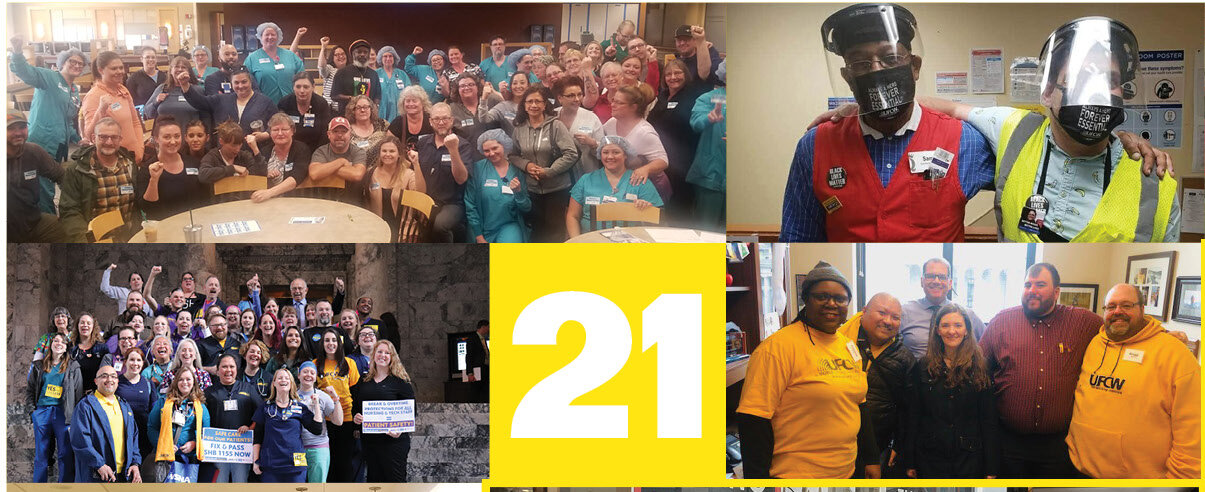
This move is out of step with the values that have made PCC a success. 

Hazard pay is not just about safety, but about the respect and dignity of essential workers. We are 1500 workers currently bargaining to reinstate hazard pay and implement much needed quarantine pay when we are exposed to or diagnosed with COVID.  
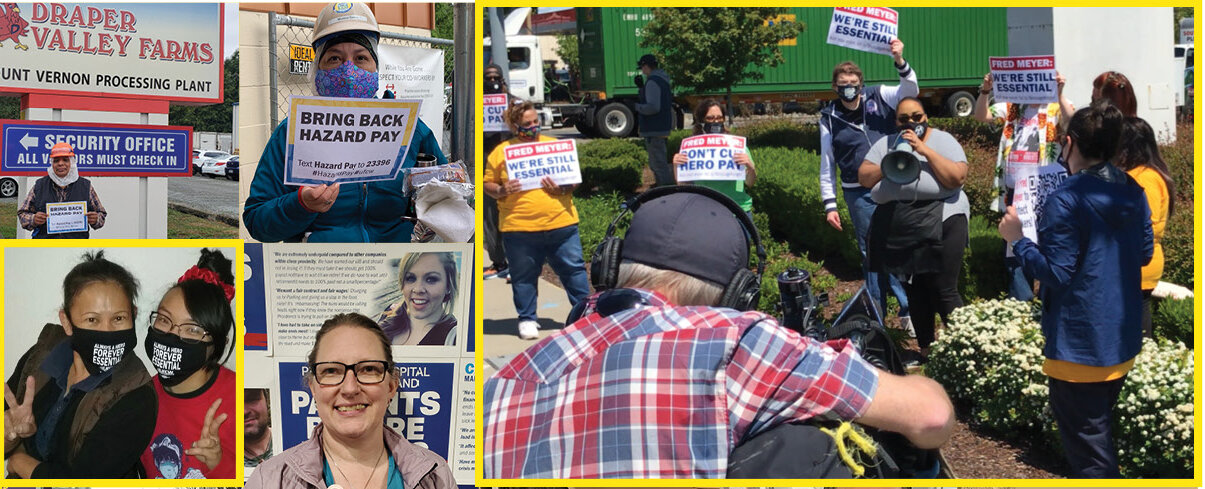
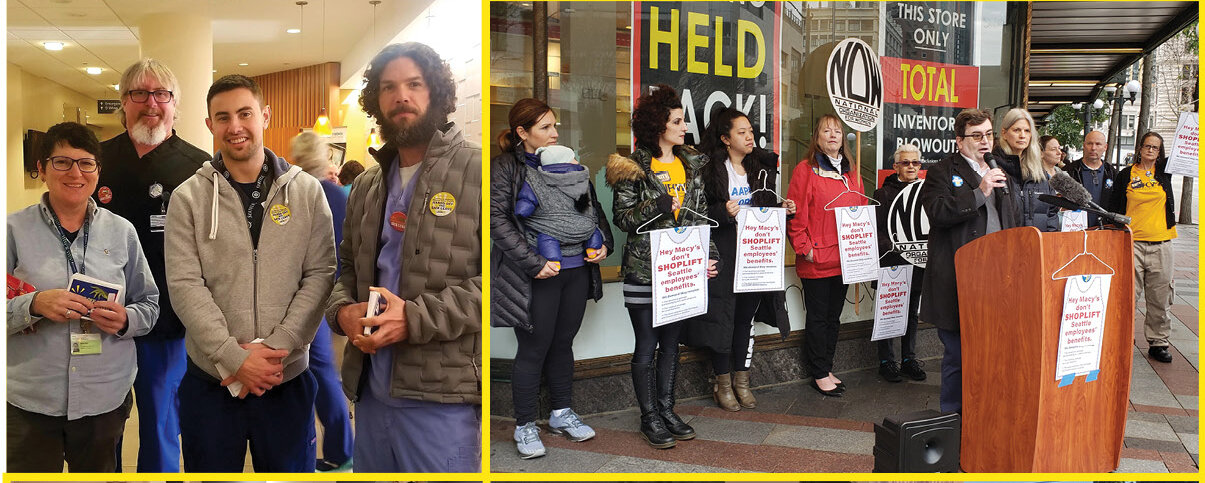
We demand that PCC reinstate hazard pay for ALL essential workers in all PCC stores and publicly withdraw their request to the Seattle Mayor and City Council. 

Seattle approves $4 hazard pay for grocery store workers

For media inquiries contact Joe Mizrahi, Secretary Treasurer UFCW 21

Help our Union fight for hazard pay in your city!  

During the COVID pandemic, grocery store operators have reaped billions of dollars in windfall profits as a direct result of the shift to at-home meal preparation but have failed to compensate workers for the added risks and burdens of working on the frontline during the pandemic. The pandemic has steadily gotten worse while grocery workers have not received hazard pay in over 6 months.

Today, thanks to the hard work, testimony, and actions of UFCW 21 members, we won $4/hour Hazard Pay for grocery store workers throughout Seattle at grocery companies with 500 or more employees worldwide. Thanks to Seattle City Councilmember Teresa Mosqueda for her leadership in bringing forward this ordinance, the over 800 UFCW 21 members and allies who contacted Seattle City Council in support of this ordinance, as well as all the members and community allies who testified before the Seattle City Council in favor of Hazard Pay by sharing their heartfelt stories and fears. The effective date, pending signature from the Mayor, is February 3, 2021. 

“I am grateful the council recognized the risks grocery store workers face during this extraordinary crisis. Thank you to our communities for hearing our stories and helping us get our voices out. Now, thanks to our hard work together, Seattle has won hazard pay for essential front line grocery store workers. This is a victory for Seattle workers, and I hope other cities follow Seattle's lead.” - Maggie Breshears, Greenwood Fred Meyer

Our union’s hard work in passing this ordinance builds on the hard work we have done to pass Initiative 1433 Statewide Sick Leave in 2016, to pass Washington State Paid Family and Medical Leave in 2017, to pass Uninterrupted Meal/Rest Breaks and close the mandatory overtime loophole for health care workers in 2019, and raising the minimum wage! 

Help fight for Hazard Pay in your city, get involved
Read the ordinance
WATCH THE COUNCIL MEETING

We believe every worker should have a voice on the job.  

Need a union?


Here’s what some UFCW 21 members have shared about hazard pay…

“Hazard pay is recognition that we are still risking our health and our lives to ensure people are able to eat. Throughout this whole pandemic, we’ve been a front line and I can see burnout happening in real time. I’ve come to work already crying, already shaking with anxiety over having to deal with unmasked customers and bus patrons on top of the taxing work. Everyone I talk to is at their wit’s end. If these pandemic conditions are to continue as the virus mutates, we deserve hazard pay. We’ve deserved it for a long time.” -Tori Nakamatsu-Figaroa, Uptown Metropolitan Market

“Hazard pay is important to me because fellow coworkers and I have to clean the protective barriers, surfaces, etc. What do they think we're cleaning!? The answer is we're cleaning COVID! It is outrageous that employees are not receiving hazard pay as of now. I have a fellow coworker who had a breakdown today because a customer was repetitively coughing on our video game cases, and we receive absolutely no compensation for cleaning up after customers. This has made me very angry.” -Björn Olson, Greenwood Fred Meyer 

“I work in Clicklist [grocery pickup] and I am responsible for caring for my 95-year-old grandmother. I am so afraid that I will unknowingly pass Covid-19 on to her. I take all the responsible actions in making sure I use latex gloves and double-mask for extra measure. I am in small living quarters with her, and if I was to pass this on to her it would most likely be a death sentence for her. That is an incredibly large burden on my shoulders. My fellow co-worker, also in Clicklist, passed it on to her mother and sadly her mother passed away. I feel as though I’m looking at my future and the end to my grandmother's life. The risk I'm taking by working at Fred Meyer and serving the community is not being acknowledged by my employer. The burden is high and the pay is low.” -Cindy Wilbur, Fred Meyer  

“Hazard pay is needed for grocery workers. We work around the public every day, risking our health to feed our families. I am a single mother of 2 small children that are at risk because I am at risk. I struggle to pay my babysitter, who basically raises my children because I am working 40+ hours just to barely survive, on top of risking not only my health but my children’s health. Kroger is making massive increases in profit while I barely scrape by.” -Hilary T.E. Williamson, QFC 

“My husband and I both work at Metropolitan Market grocery. I am on leave of absence for health reasons and to help care for our child while they are distance learning. We are currently relying solely on my husband's income and a few assistance programs to get by. I've also lost my insurance due to sheltering. Hazard pay would be so helpful to offset my lack of income and help us keep on top of bills and rent. It would also help my husband and coworkers feel as though they're valued as essential workers and that their sacrifice at this time isn't going without notice.” -Holly Jansma, Metropolitan Market 

20/20 Looking Back and Looking Forward

Dear UFCW 21 members,  

At the start of a new year, we find ourselves looking back and looking forward. 2020 was an intense year for most of us, and we face 2021 still in the grip of a public health and economic crisis, alongside a reckoning on racial oppression and an assault on our democracy.  

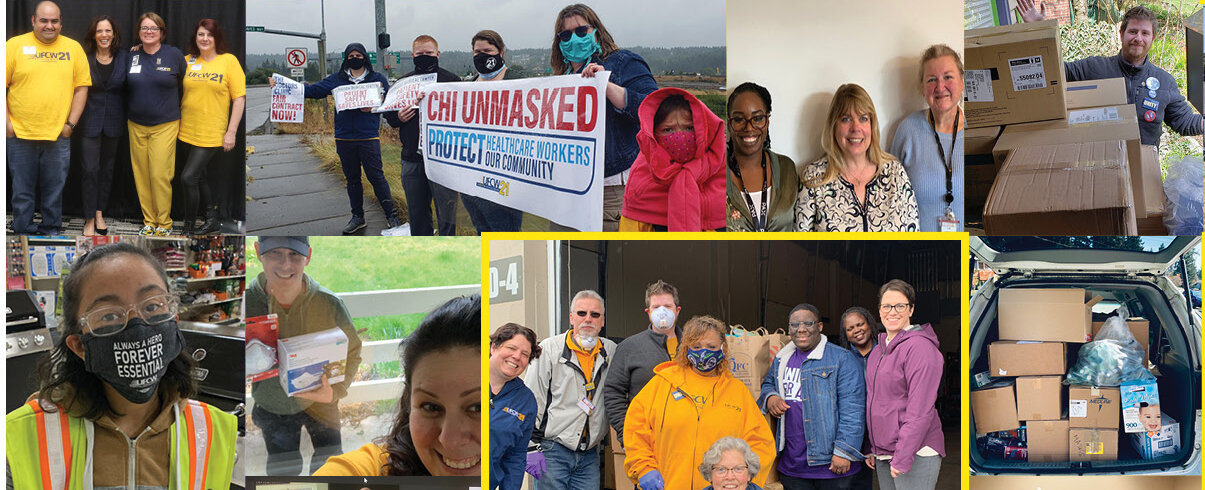
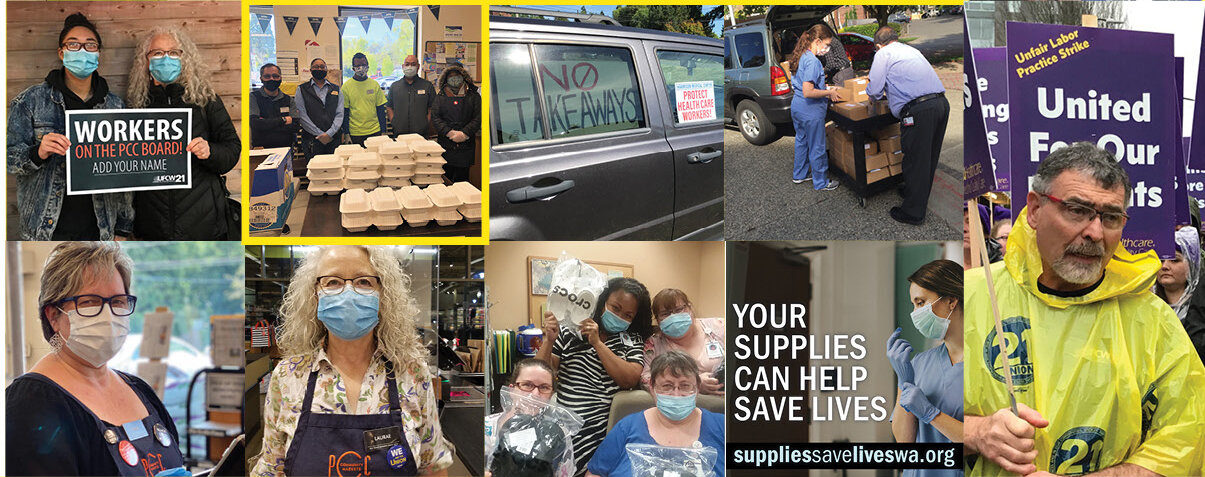
But we also face this new year together, as a union of over 46,000 working people. Many UFCW 21 members put their lives on the line in 2020 to show up for work and keep our communities fed, supplied, and cared for. Thousands of you newly joined us in 2020, making our union stronger in the face of challenges. We have grieved together, celebrated together, and stood side by side fighting for fair pay and safe working conditions.  

Together in 2020 we: 

Settled 25 contracts, including 70 Memorandums of understanding with employers around COVID safety and benefits. 

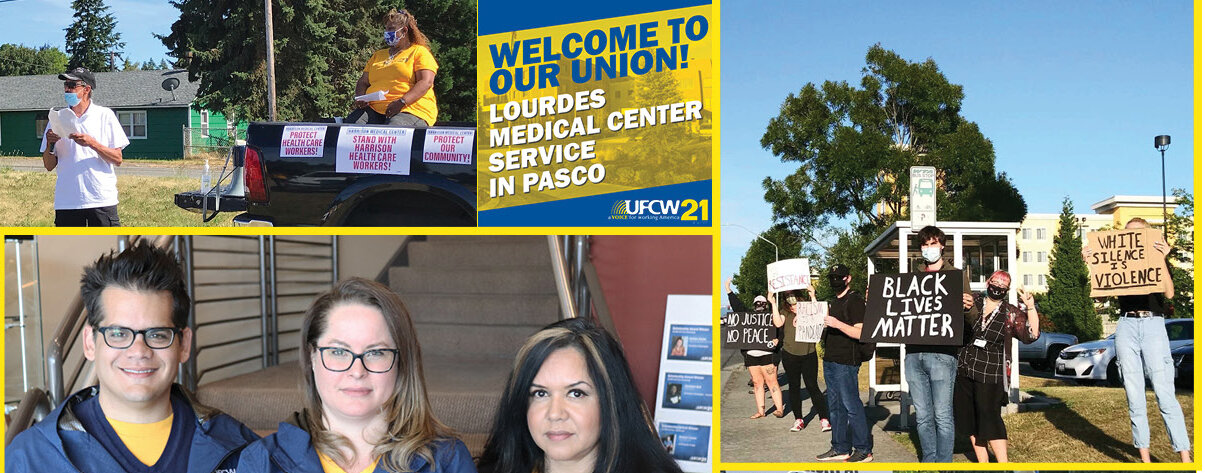
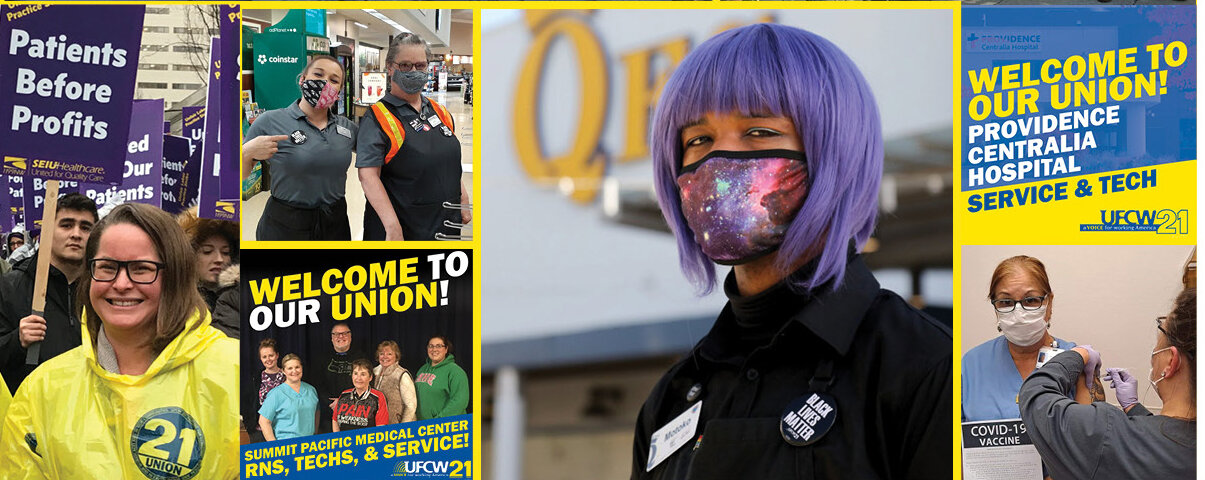
Welcomed 8,378 new members into our union, including 1,023 members from 8 new units who organized unions at their workplaces for the first time! 
Welcome to our union: 

Providence St Peter Techs 
Summit Pacific Medical Center RNs, Techs, and Service 
Providence Centralia Techs and Service 
Lourdes Medical Center Service 
Seattle Children’s Hospital Medical Assistants 
Metropolitan Market Mercer Island 
PCC Central District 
14 QFC ClickList locations 
Kaiser Pharmacy workers 

Conducted 41 Telephone Town Hall calls with thousands of members. 

Came together and donated 141,867 pieces of Personal Protective Equipment to frontline workers including: 95,600 Gloves, 18,353 N95 Masks, 9,740 goggles, and 6,175 Surgical Masks. 

We awarded $42,000 to our 2020 Scholarship Recipients

2021 will certainly bring new opportunities to accomplish our top priorities, including:  

Hazard pay for all essential workers. 

Priority vaccine access for essential workers and vulnerable populations. 

Personal protective equipment wherever it is needed. 

Child care support for working families.  

Maintain workers’ right to safety, including enforcement of COVID safety requirements and our right to workplaces free from discrimination. 

Milestones in our training and workforce development programs. 

Passing a Worker Protection Act and a financial transparency bill for big health care systems in Washington State. 

We will win these at bargaining tables, through our city councils and state legislature, through outreach in the press, and directly in our communities and workplaces by speaking up for what we know is right, caring for each other so we can stay in the fight, and standing together in solidarity as a union family.  

If you have questions or concerns, do not hesitate to reach out. Join us at the Winter General Membership Meetings, check out all the resources on our union website at UFCW21.org, call us at 1-800-732-1188, and get involved however you can. If you need help, you can always file a safety report at safetyreport@ufcw21.org or reach the Rep of the Day at (206) 436-6578.  

In solidarity, Faye & Joe  

Faye Guenther, President, UFCW 21 

Joe Mizrahi, Secretary-Treasurer, UFCW 21 

Grocery Store Worker Telephone Town Hall Call

Join us for a special Grocery Store Worker
Telephone Town Hall!
Tuesday, January 19, 6:30PM


Call-in number: 888-652-0383
Meeting ID: 5662

Join to discuss bargaining and hazard pay ordinances, get your questions answered, and connect with other union grocery store workers. Expect a call from us around 6:30, but if you miss the call or don’t receive one, just call in yourself with the number and meeting ID!


JOIN THE FIGHT:


SPEAK UP: Why is hazard pay important to you and your coworkers? Share a quick video or written message! Share why hazard pay is important to you >>

TESTIFY: These days, speaking before city council can be done from your own home, car, or break room because meetings are held online. Live or work in Seattle or Burien? Sign up for more information, and we’ll connect with you when there’s a city council hearing you could speak at! Sign up to speak at a council meeting >>

START SOMETHING: Do you want to bring up a hazard pay ordinance in your city or county? Sign up and a UFCW 21 organizer will connect with you for a training on how to move an ordinance through your city! Sign up for a training on organizing for hazard pay ordinances >>

WHEN WE FIGHT, WE WIN.

Celebrating Martin Luther King, Jr. Day 2021

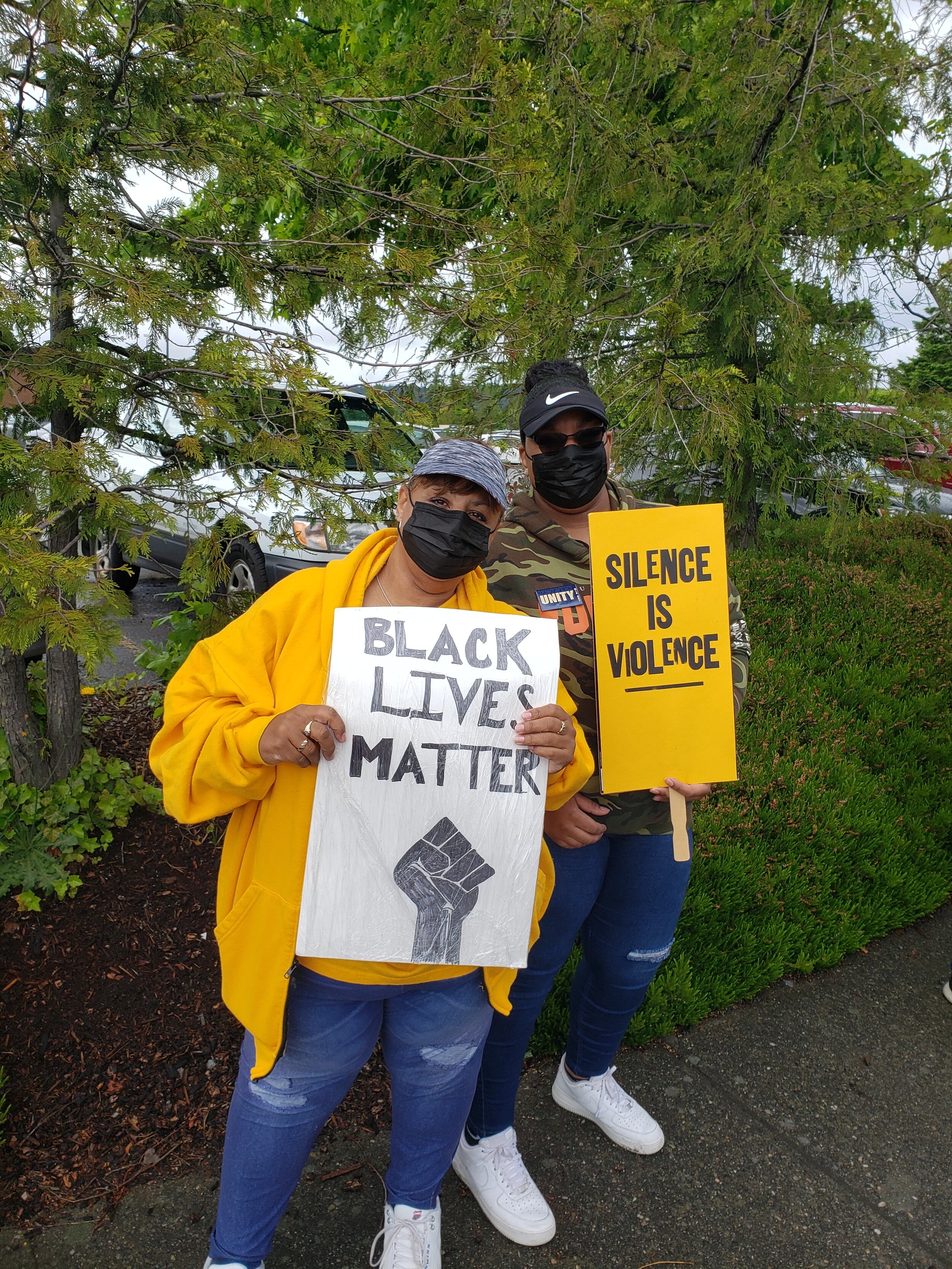
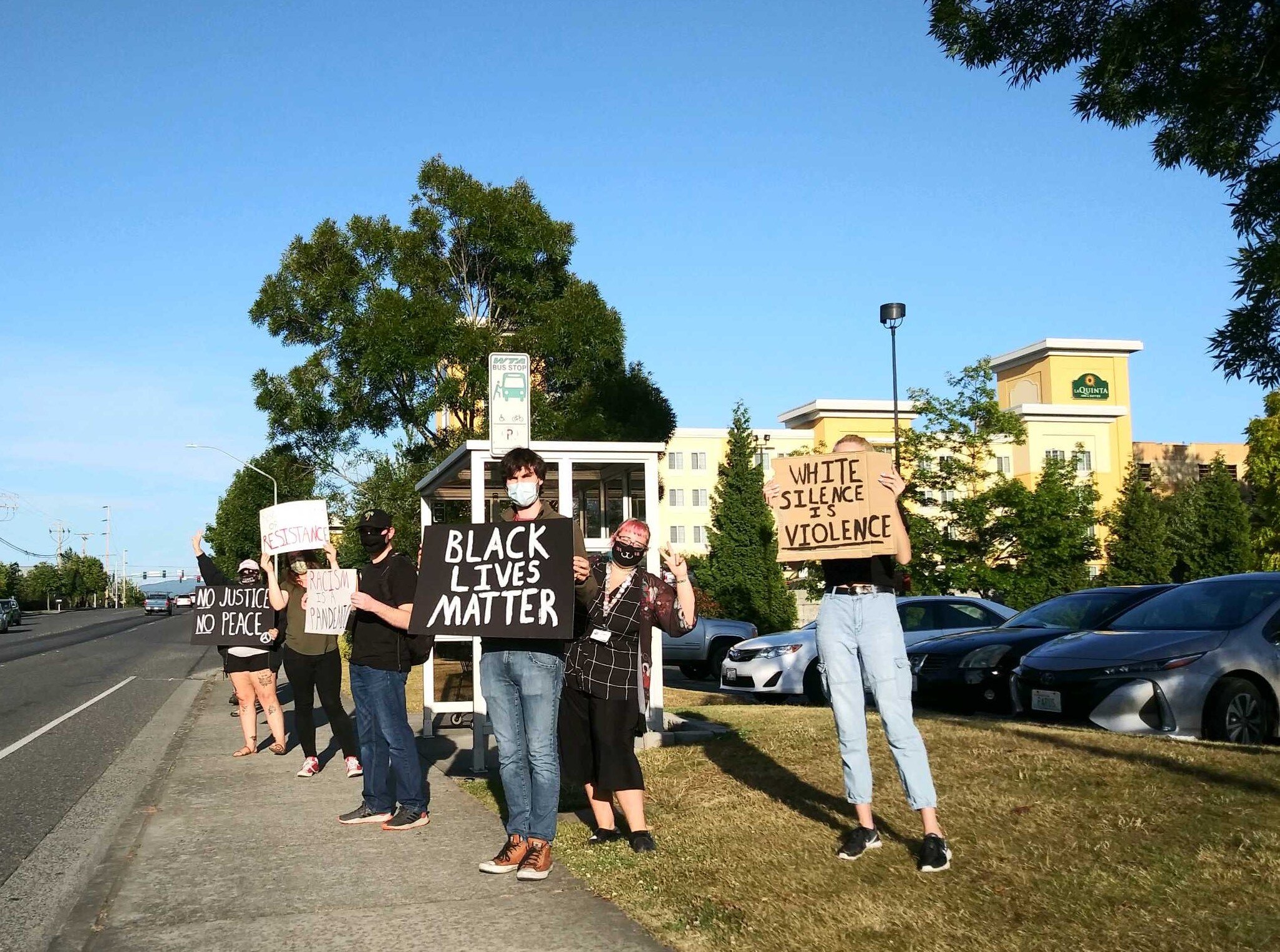
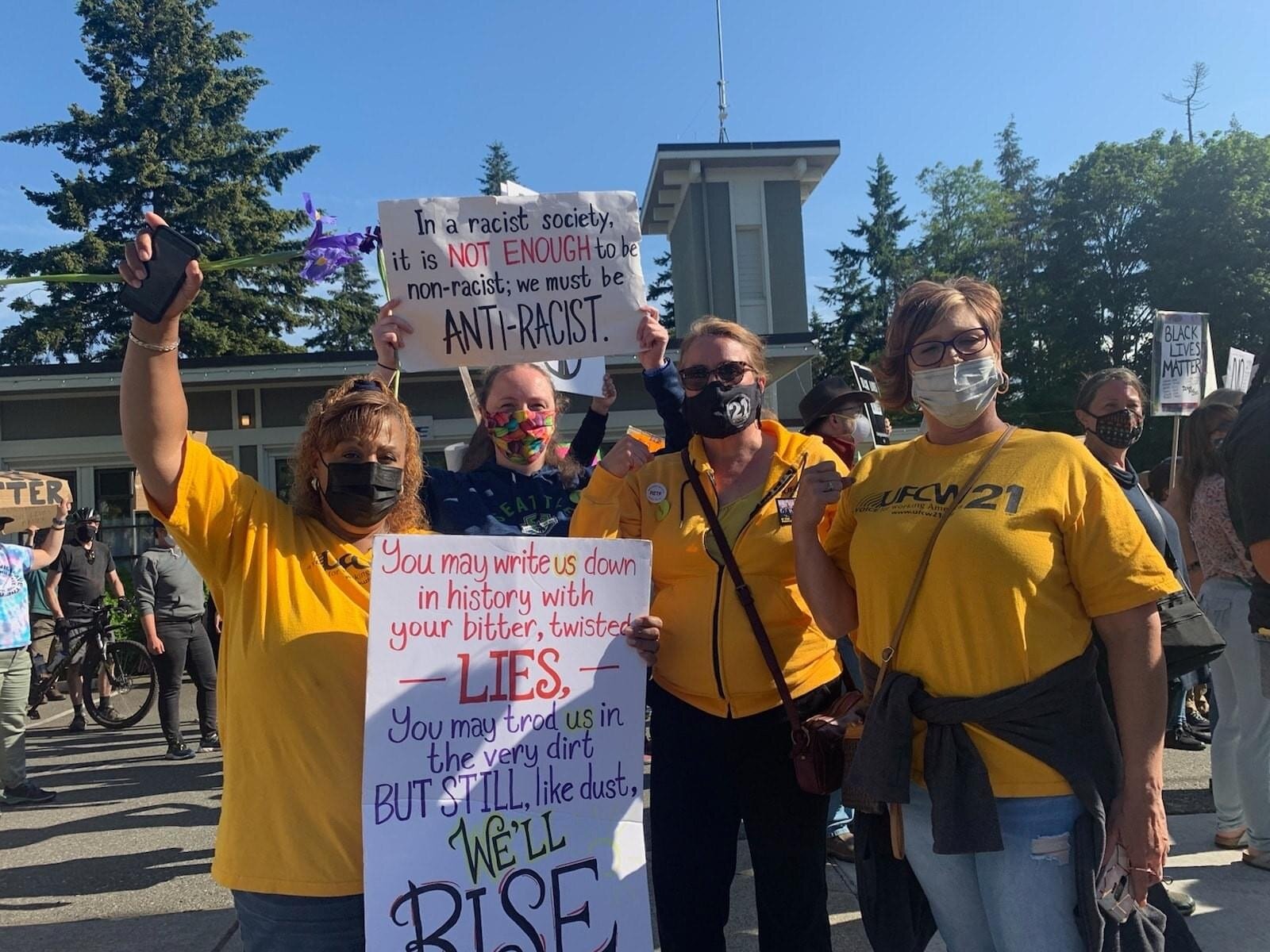
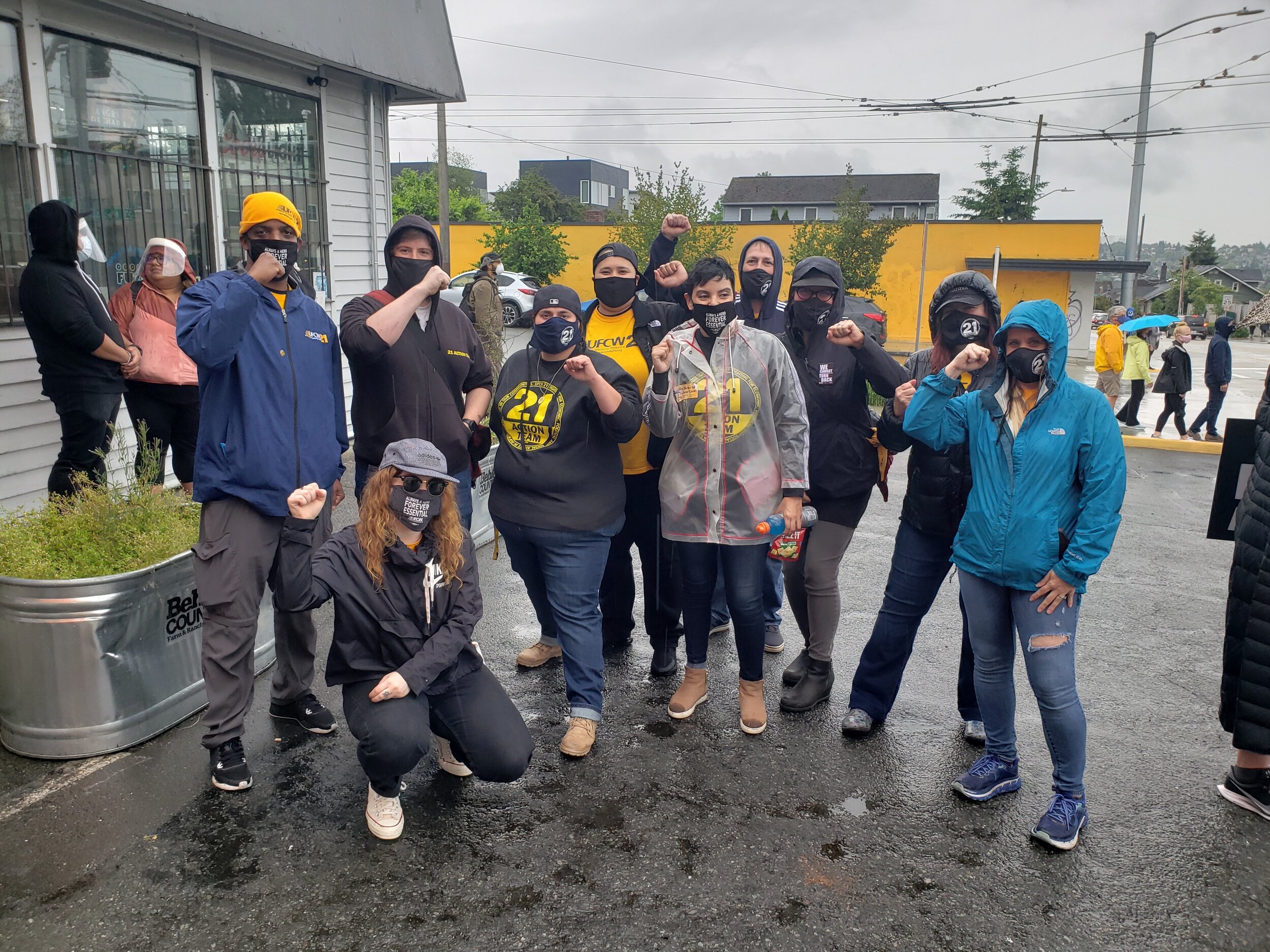
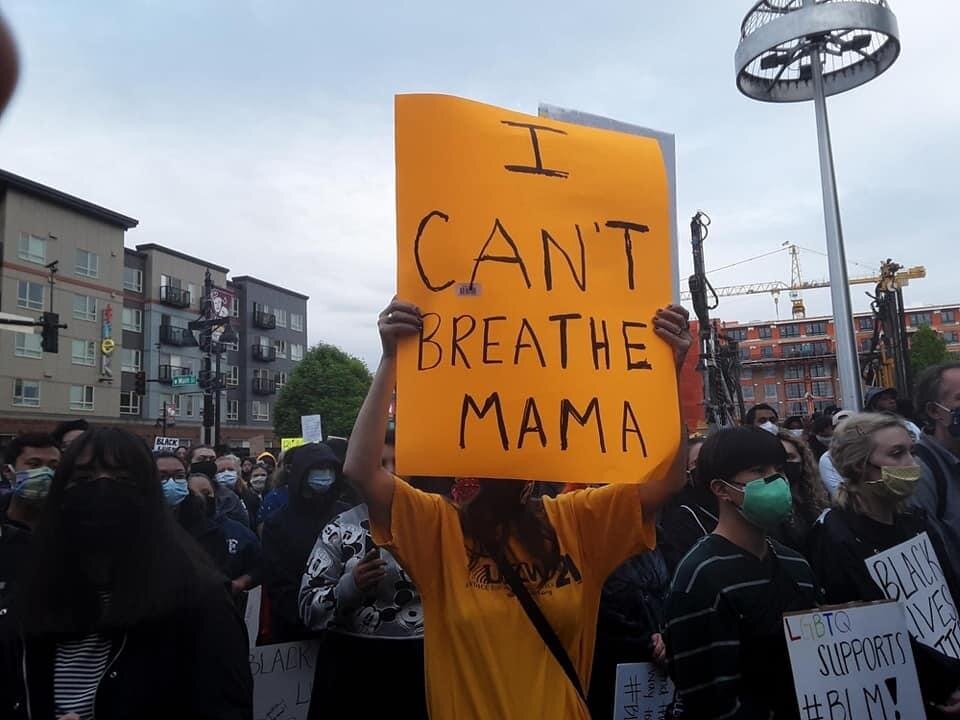
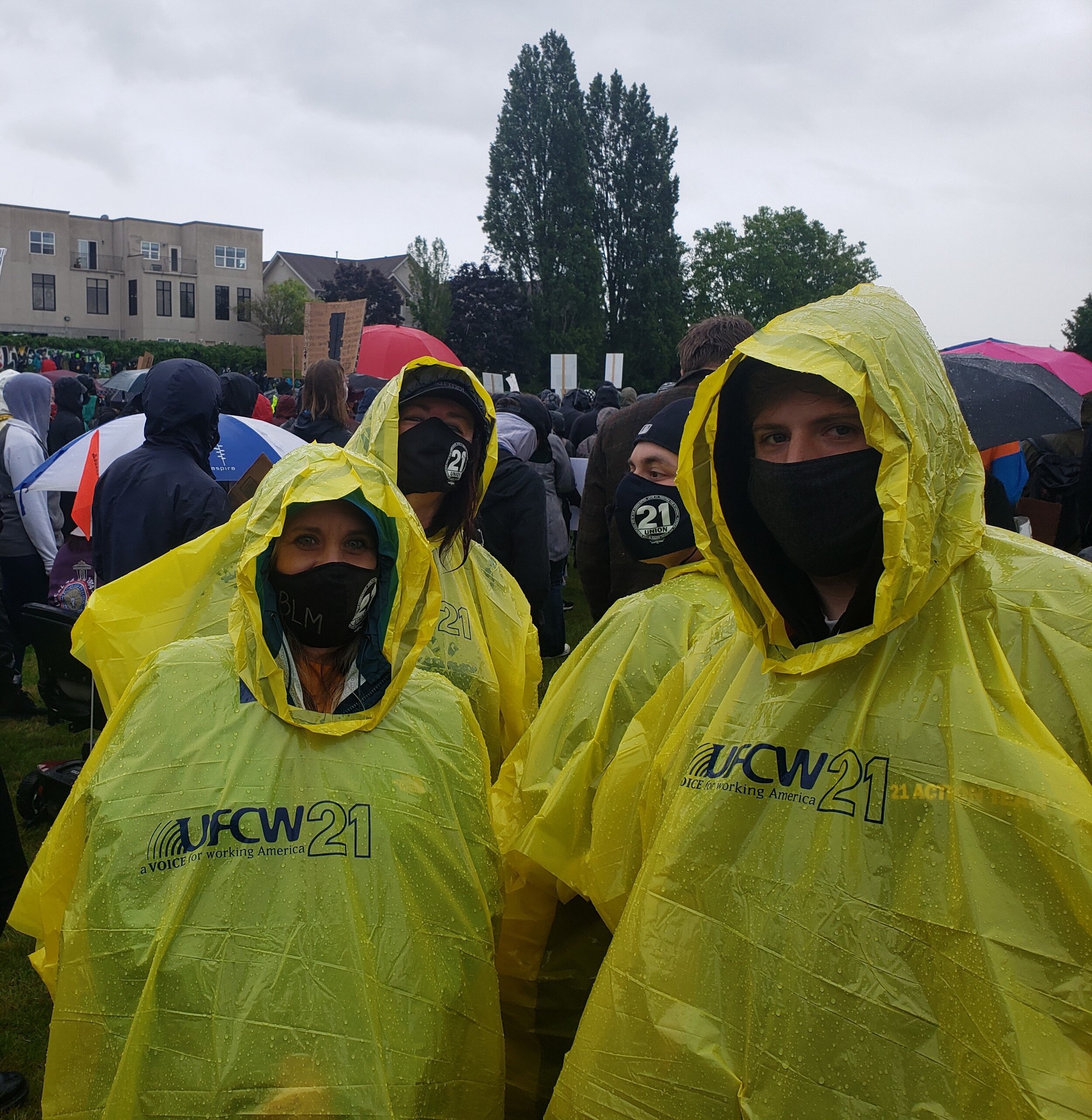
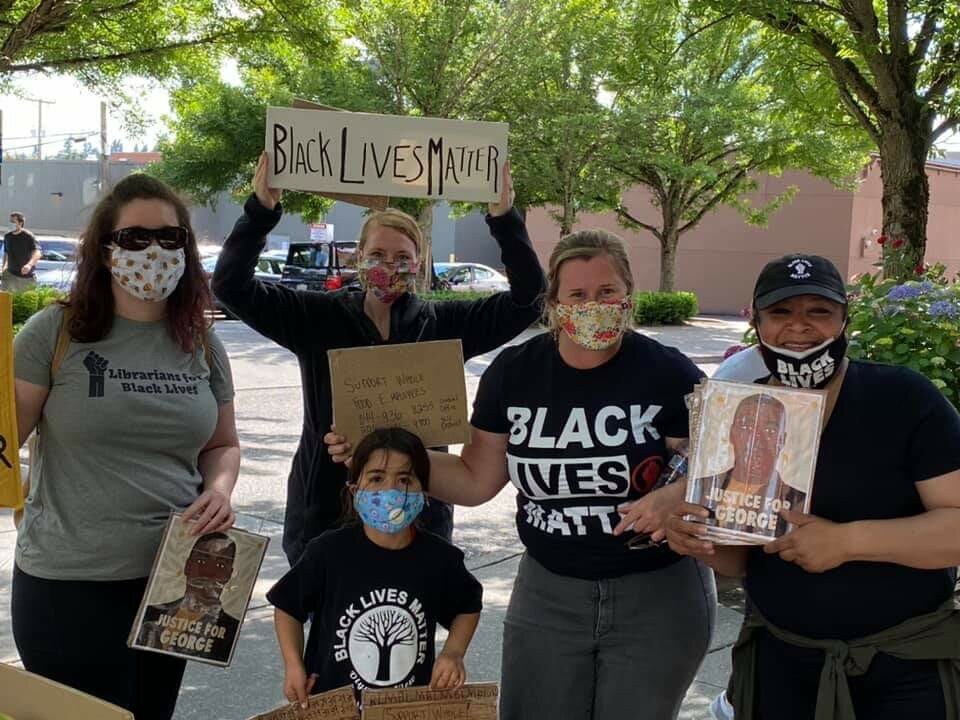
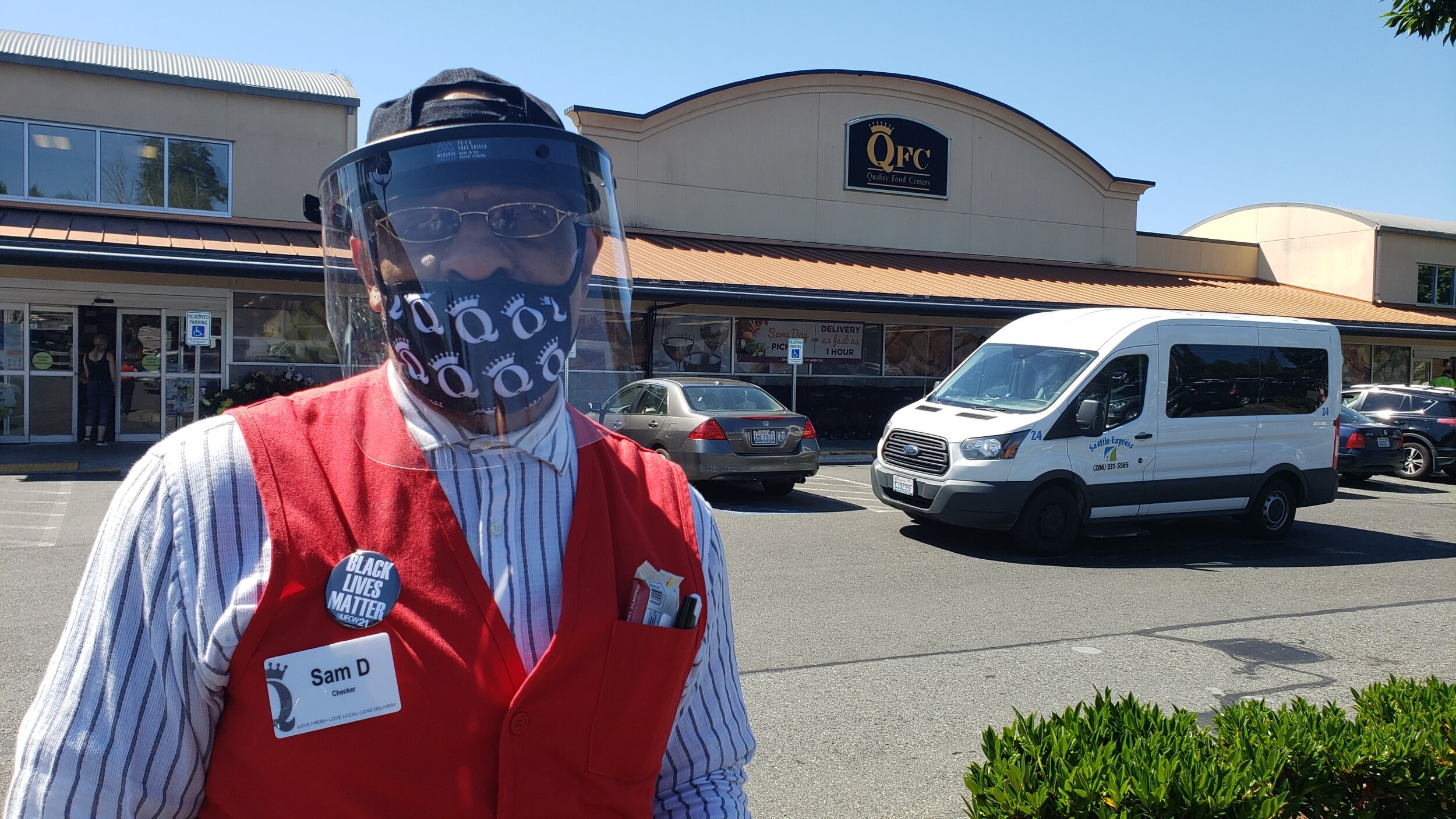
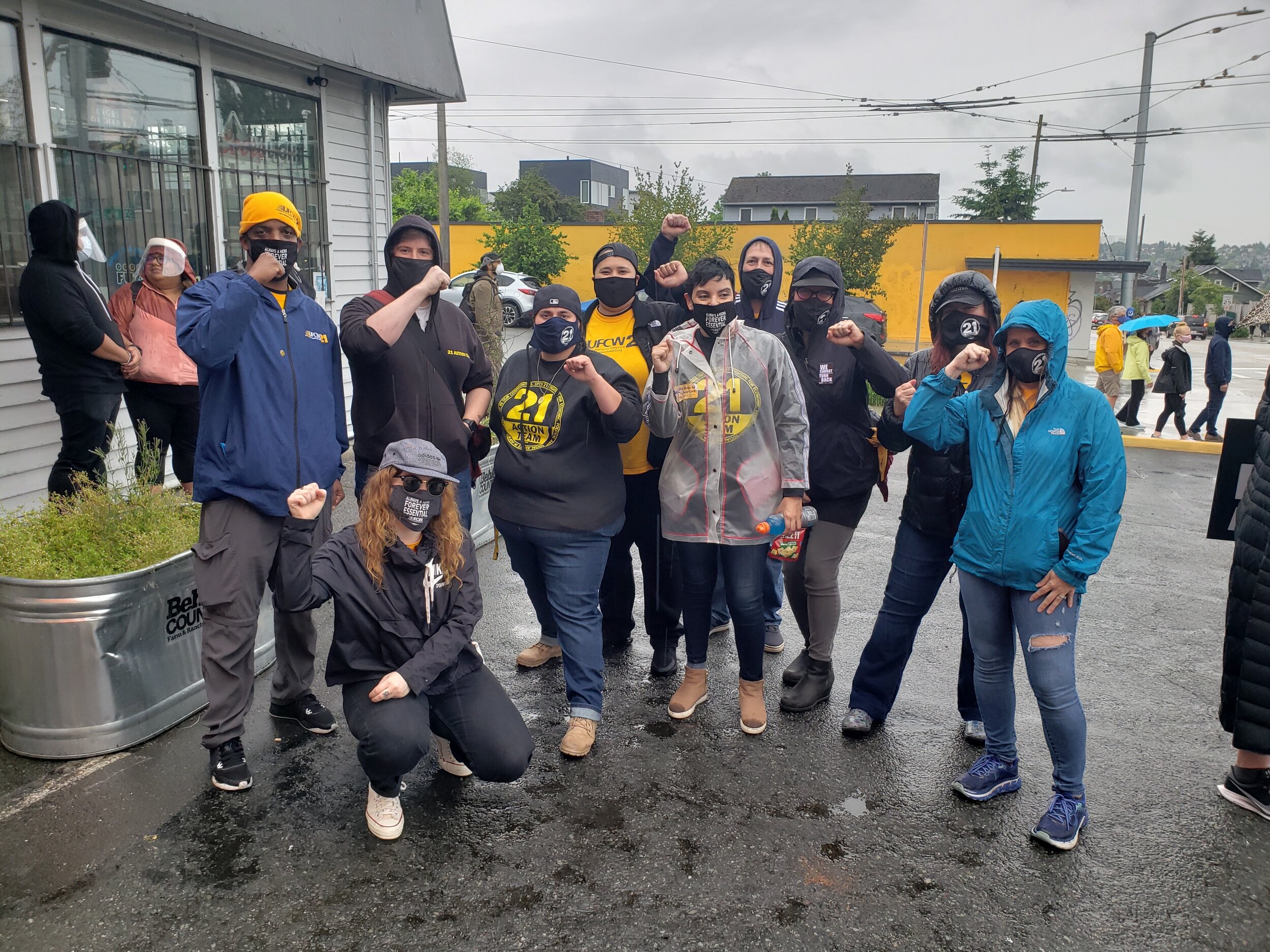
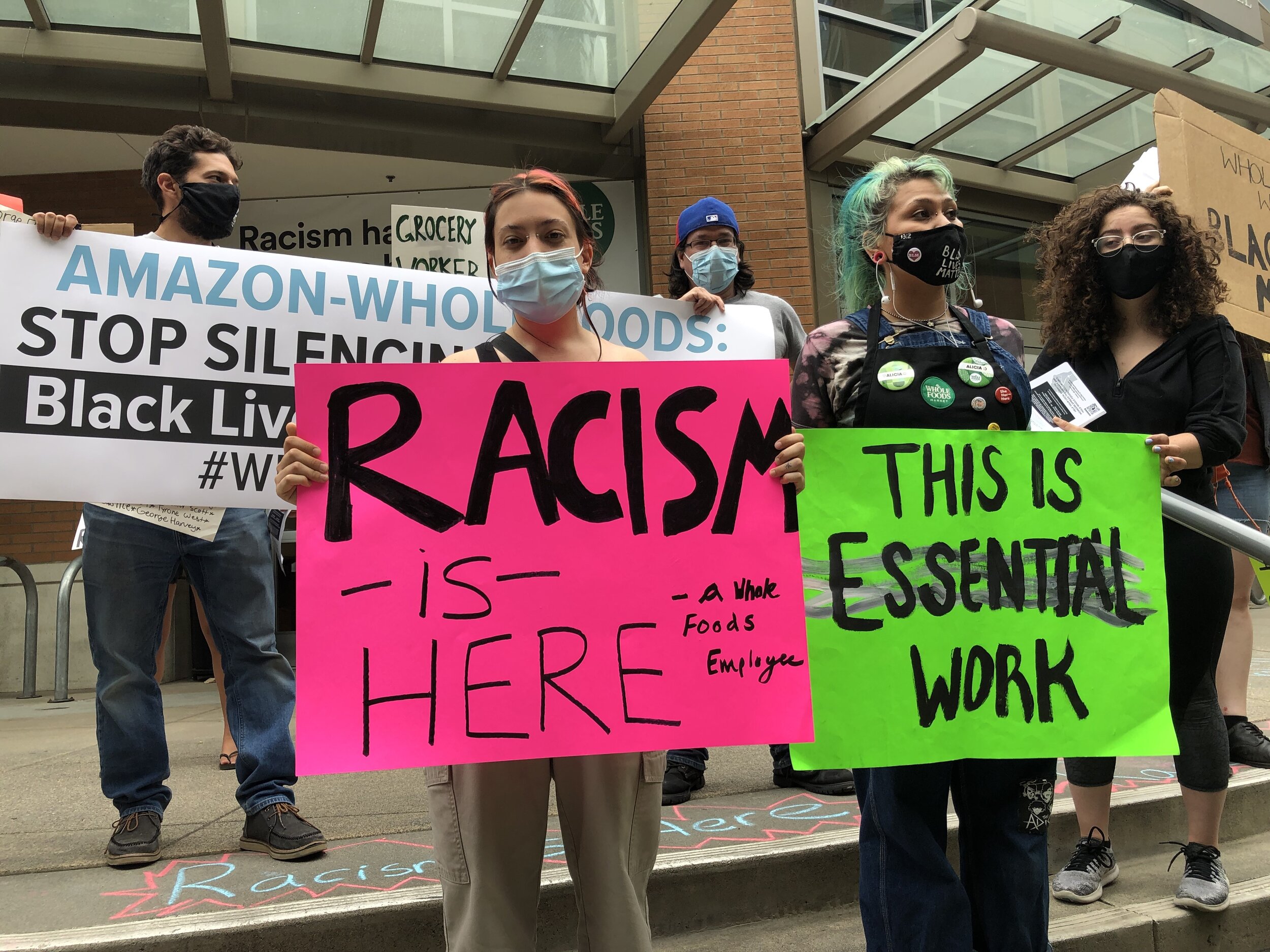
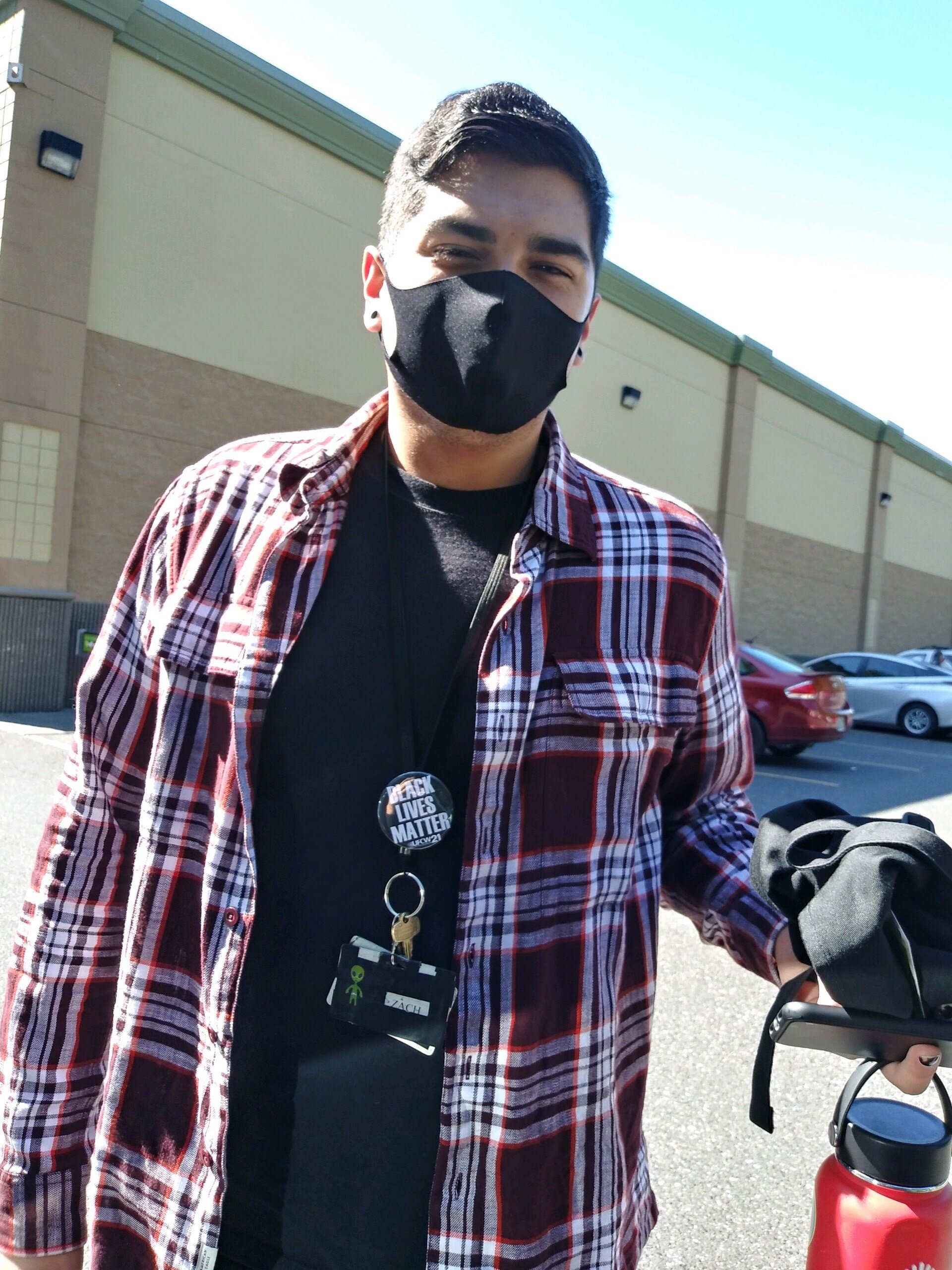
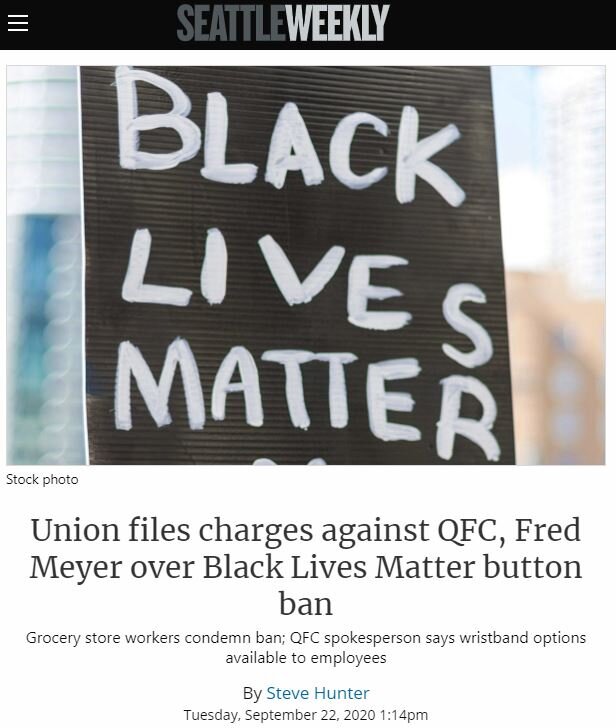
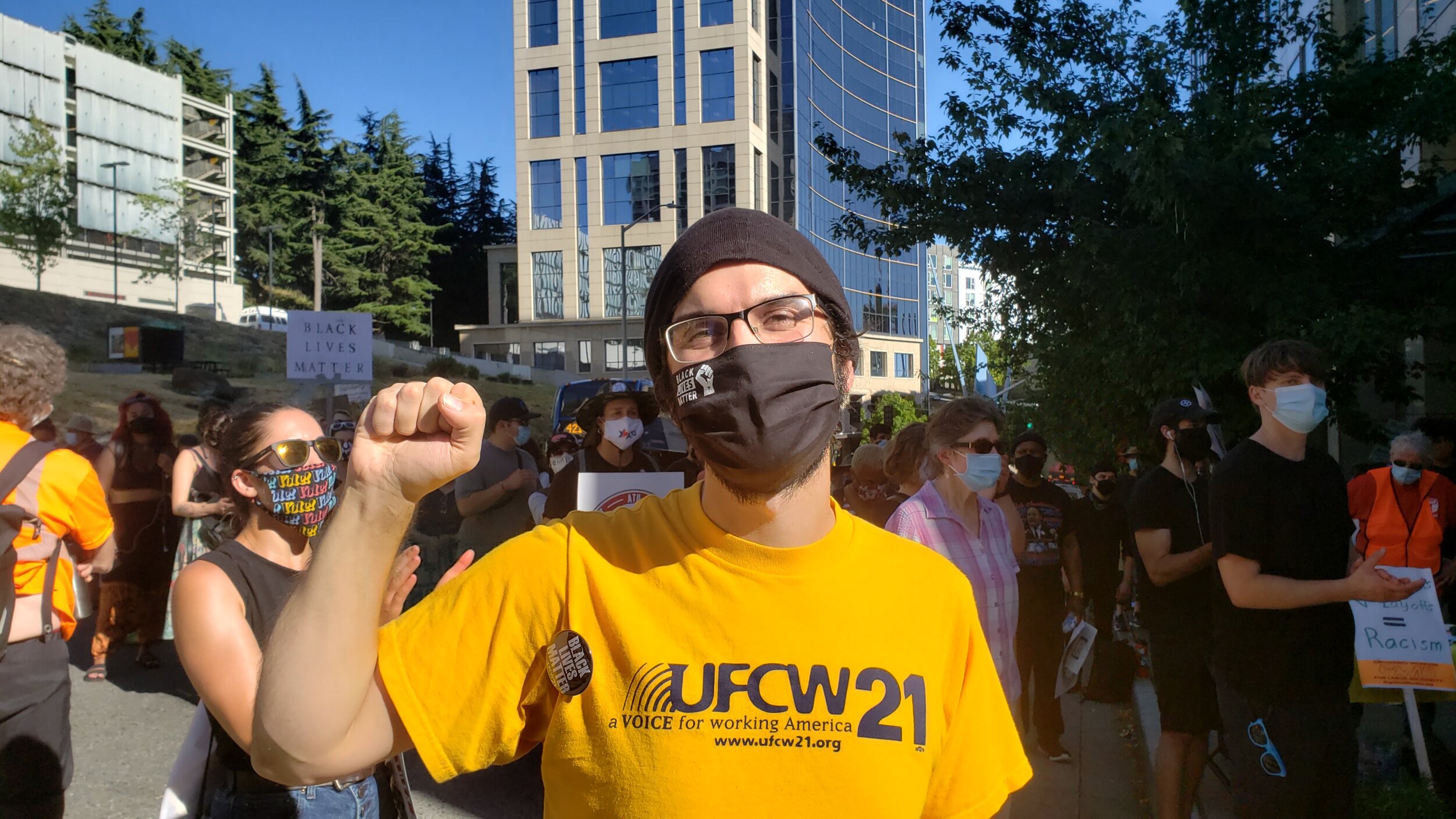
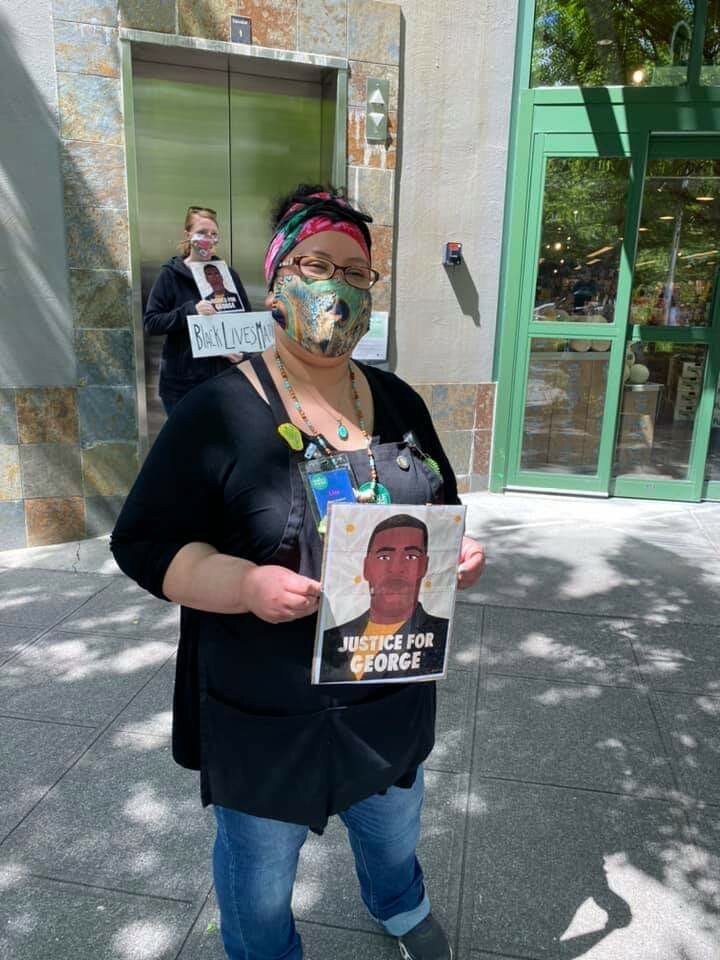
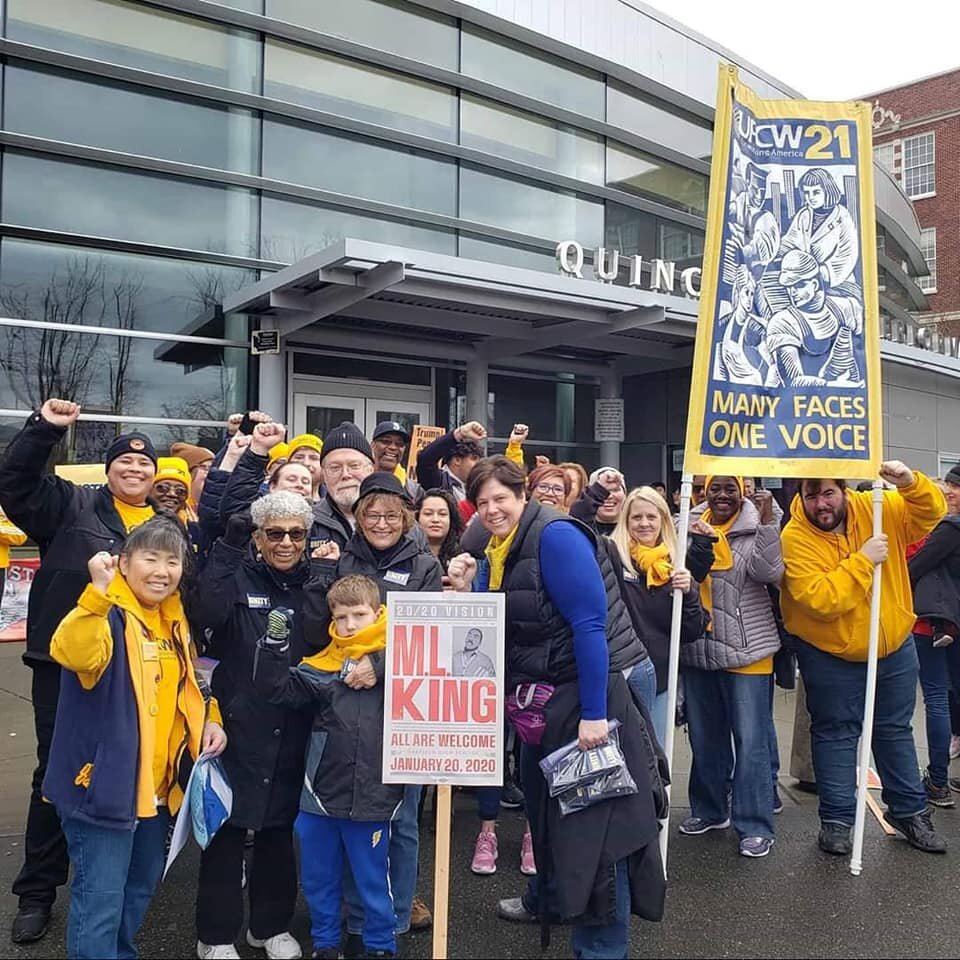
Pictured: UFCW 21 members and our allies took action for racial justice in many ways in 2020.


This weekend, Jan 16-18th 2021, honors the legacy of Dr. Martin Luther King Jr., who lived and died struggling for racial equity and labor rights, as well as the current movement for Black lives which is built upon his shoulders. We at UFCW 21 are celebrating differently than we have in recent years. Over the past decade, we distributed tens of thousands of Dr. King-inspired buttons and marched in the streets led by a powerful movement of youth and elders, shining a light on the racial injustices that still exist in our communities.

This year, as UFCW 21 members in health care, grocery stores, drug stores, food processing, and other workplaces are on the front lines of the COVID 19 pandemic every day, we are encouraging everyone to honor Dr. King by taking care of ourselves and each other, and supporting our families and our communities. Dr. King showed us the way to the Beloved Community, a society based on justice, equal opportunity, and love of all humans.

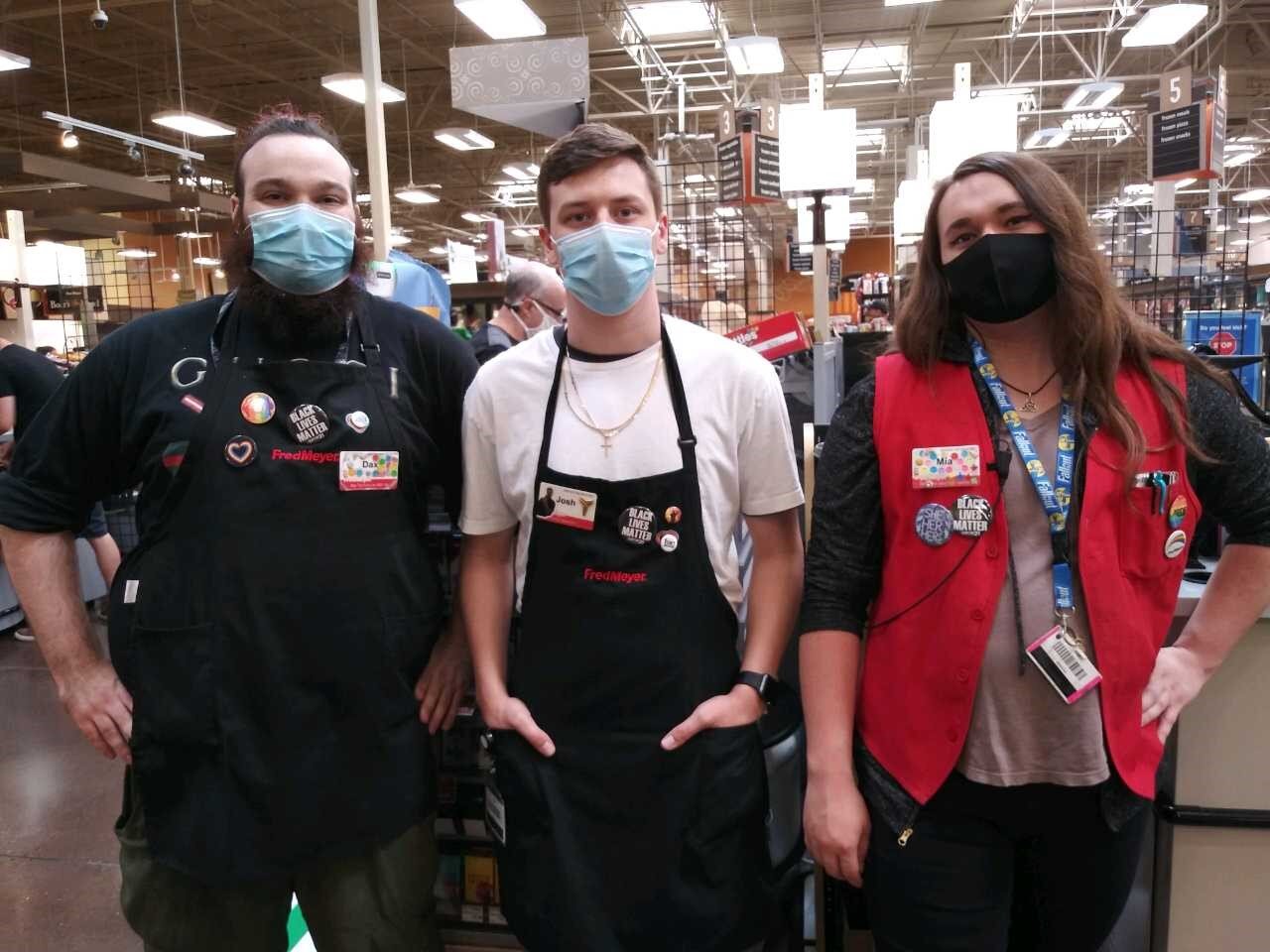
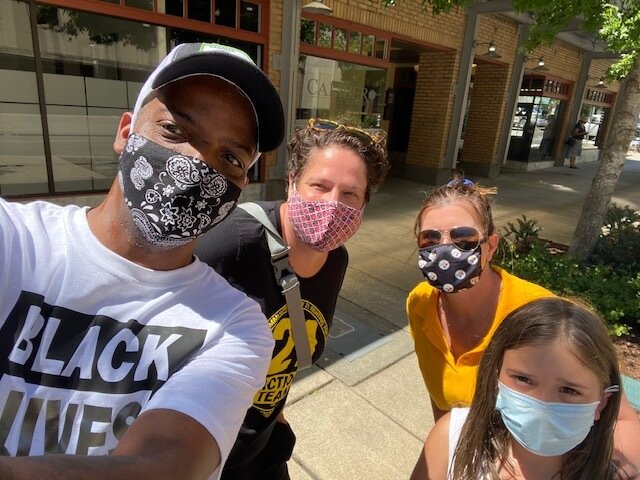
Wherever you are on Martin Luther King Jr. Day, Monday January 18, wear your union Black Lives Matter or other union solidarity button and remember you are part of a historical movement that recognizes the dignity of all workers and all work. Whomever you are and whatever you do, you deserve a voice on the job, to be safe and healthy, and to thrive.

Events you can attend online to celebrate the holiday

Important reflections from Black labor leaders across our state over this last year:

January 11th Member Telephone Town Hall

As COVID restrictions make it more difficult to meet in person and members face increased risks and concerns around COVID safety and other issues, we are continuing regular Telephone Town Hall calls for members to get important updates, ask questions of union leadership and special expert guests, and come together to plan how we can keep each other safe and fight for fairness at work even during this ongoing crisis.


JOIN US!

UFCW 21 Member Telephone Town Halls

Monday, January 11, 2021

6:30pm & 7:30pm

We will call you at the appropriate time, so all you have to do is pick up the phone when it rings at 6:30 or 7:30 pm on Monday. If you miss the call or don’t receive one, just call in directly using the meeting information below. You’ll have a chance to ask questions, participate in polls, and hear from fellow UFCW 21 members.

6:30 pm, Mon. Jan. 11

UFCW 21 Member Telephone Town Hall

Invited: All UFCW 21 members except in health care workplaces (see below for health care member call)

Special Guest: UFCW International Union President Marc Perrone!

☎️ Attendee Phone Number: 888-652-0383, Meeting ID: 5592


7:30 pm, Mon. Jan. 11

UFCW 21 Health Care Member Telephone Town Hall

Invited: All UFCW 21 members in health care workplaces

☎️ Attendee Phone Number: 888-652-5403, Meeting ID: 5593


Employers and Lawmakers need to keep hearing from us!

Why is Hazard Pay so important to you and your co-workers? Reply with a video message or a written message.

Statement from UFCW 21 President Faye Guenther and Secretary Treasurer Joe Mizrahi on today’s assaults on the capitols in Olympia and Washington, D.C.

“We call on all elected leaders to finish what they started and certify the 2020 presidential election. Hate groups, lies purposely spread by certain elected officials, tantrums and riots fueled by false conspiracy theories and racism will not derail democracy. We are one when it comes to protecting our democracy, our Constitution, and each other.

We believe in the democratic process, in our union and in our country. The people voted. Biden won. And today, Warnock and Ossoff won in Georgia. That is how you take the halls of congress. That is how democracy works. The people have spoken.

We are thankful our elected officials are safe, including Governor Inslee and our longtime ally Representative Jayapal, who was in the House Gallery today. We will not tolerate bullies here or in Washington D.C.”

-UFCW 21 President Faye Guenther and Secretary Treasurer Joe Mizrahi

Knowing your rights: The Labor-Management Reporting and Disclosure Act (LMRDA)

The Labor Management Reporting and Disclosure Act and Other Federal Labor and Employment Laws Protecting Workers’ Rights

Keeping members informed about their rights and the resources our union provides is essential to protecting them on the job. As part of this effort, you can learn more about the Labor Management Reporting and Disclosure Act (LMRDA), which only protects those workers who are union members, and other federal labor and employment laws, which generally protect all workers.

The Labor-Management Reporting and Disclosure Act (LMRDA) grants certain rights to union members and protects their interests by promoting democratic procedures within labor organizations. The LMRDA establishes the following:

  • Bill of Rights for union members

  • Reporting requirements for labor organizations, union officers and employees, employers, labor-relations consultants, and surety companies

  • Standards for the regular election of union officers

  • Safeguards for protecting labor organization funds and assets

Unions representing federal employees are similarly covered by the implementing regulations of the standards of conduct provisions of the Civil Service Reform Act. Unions representing solely state, county, and municipal employees are not covered by either of these laws.

The Secretary of Labor enforces certain provisions of the LMRDA and has delegated that authority to the Office of Labor-Management Standards (OLMS). Other provisions may only be enforced by union members through a private suit in a federal district court. Major provisions of the LMRDA are outlined below.

Title I - Bill of Rights of Union Members

  • Union members have equal rights to nominate candidates for union office, vote in union elections, and participate in union meetings. They may also meet with other members and express any opinions.

  • Unions may impose assessments and raise dues only by democratic procedures.

  • Unions must afford members a full and fair hearing of charges against them.

  • Unions must inform their members about the provisions of the LMRDA.

  • Members may enforce Title I rights through a private suit against the union, but may be required to exhaust internal union remedies for up to four months before filing suit.

  • Union members and nonunion employees may receive and inspect collective bargaining agreements. This right may be enforced by the individual or by the Secretary of Labor.

Title II - Reporting Requirements

  • Unions must file information reports, constitutions and bylaws, and annual financial reports with OLMS.

  • Officers and employees of labor unions must report any loans and benefits received from, or certain financial interests in, employers whose employees their unions represent and businesses that deal with their unions.

  • Employers and labor-relations consultants who engage in certain activities to persuade employees about their union activities or to supply information to the employer must file reports.

  • Surety companies that issue bonds required by the LMRDA or the Employee Retirement Income Security Act must report data such as premiums received, total claims paid, and amounts recovered.

  • The Secretary of Labor has authority to enforce the reporting requirements of the LMRDA.

  • The reports and documents filed with OLMS are public information and any person may examine them or obtain copies at OLMS offices or via the OLMS Internet Public Disclosure Room at www.unionreports.dol.gov.

  • Filers must retain the records necessary to verify the reports for at least five years after the reports are filed.

  • Unions must make reports available to members and permit members to examine records for just cause.

Title III - Trusteeships

  • A parent union that places a subordinate body under trusteeship must file initial, semiannual, and terminal trusteeship reports.

  • A trusteeship may only be imposed for the purposes specified in the LMRDA and must be established and administered in accordance with the constitution and bylaws of the labor organization that has imposed the trusteeship.

  • A parent union that imposes a trusteeship may not engage in specified acts involving the funds and delegate votes from a trusteed union.

  • The Secretary of Labor has authority to investigate alleged violations of this Title. A union member or a subordinate labor organization may also enforce the trusteeship provisions except for the reporting requirements.

Title IV - Elections

  • Local unions must elect their officers by secret ballot; international unions and intermediate bodies must elect their officers by secret ballot vote of the members or by delegates chosen by secret ballot.

  • International unions must hold elections at least every five years, intermediate bodies every four years, and local unions every three years.

  • Unions must comply with a candidate's request to distribute campaign material to members at the candidate's own expense and must also refrain from discriminating against any candidate with respect to the use of membership lists. Candidates have the right to inspect a list containing the names and addresses of members subject to a union security agreement within 30 days prior to the election.

  • A member in good standing has the right to nominate candidates, to be a candidate subject to reasonable qualifications uniformly imposed, to hold office, and to support and vote for the candidates of the member's choice.

  • Unions must mail a notice of election to every member at the member's last-known home address at least 15 days prior to the election.

  • A member whose dues have been withheld by an employer may not be declared ineligible to vote or to be a candidate for office by reason of alleged delay or default in the payment of dues.

  • Unions must conduct regular elections of officers in accordance with their constitution and bylaws and preserve all election records for one year.

  • Union and employer funds may not be used to promote the candidacy of any candidate. Union funds may be utilized for expenses necessary for the conduct of an election.

  • Union members may hold a secret ballot vote to remove from office an elected local union official guilty of serious misconduct if the Secretary of Labor finds that the union constitution and bylaws do not provide adequate procedures for such a removal.

  • Union members who have exhausted internal union election remedies or who have invoked such remedies without obtaining a final decision within three calendar months after their invocation may file a complaint with the Secretary within one calendar month thereafter.

  • The Secretary of Labor has authority to file suit in a federal district court to set aside an invalid election and to request the court to order a new election under the supervision of the Secretary and in accordance with Title IV.

Title V - Safeguards for Labor Organizations

  • Officers have a duty to manage the funds and property of the union solely for the benefit of the union in accordance with its constitution and bylaws.

  • A union officer or employee who embezzles or otherwise misappropriates union funds or other assets commits a federal crime punishable by a fine and/or imprisonment.

  • Officials who handle union funds or property must be bonded to provide protection against losses.

  • A union may not have outstanding loans to any one officer or employee that in total exceed $2,000.

  • A union or employer may not pay the fine of any officer or employee convicted of any willful violation of the LMRDA.

  • Persons convicted of certain crimes may not hold union office or employment for up to 13 years after conviction or after the end of imprisonment.

Title VI - Miscellaneous Provisions

  • Authority is granted to the Secretary of Labor to investigate possible violations of most provisions of the LMRDA (except those specifically excluded) and to enter premises, examine records, and question persons in the course of the investigation.

  • A union or any of its officials may not fine, suspend, expel, or otherwise discipline a member for exercise of rights under the LMRDA.

  • No one may use or threaten to use force or violence to interfere with a union member in the exercise of LMRDA rights.


Last Updated: 11-29-17