Grocery Store COVID-19 Safety Checklist

Coronavirus is a serious workplace health hazard. All employers have a responsibility to provide a workplace free of safety and health hazards. If your grocery store employer is not complying with any part of this checklist, contact your Union Rep or file a safety report with UFCW 21 at safetyreport@ufcw21.org.

If you are not a UFCW 21 member and have questions about your safety at work, text a UFCW 21 organizer at: 803-820-2121


Click here for a printable version of this checklist

SAFETY CHECKLIST FOR GROCERY STORES IN WASHINGTON STATE

SIGNAGE:

  • Conspicuous signage at entrances and throughout the store with occupancy limits, policy on face coverings, six-foot physical distancing guidelines, and instructing customers to stay home if they are experiencing symptoms of COVID-19

  • 6-foot distance markers in checkout lines and other high-traffic areas to maintain 6 feet of physical distancing

PHYSICAL DISTANCING & BARRIERS:

  • 6-foot physical distance is maintained and enforced between all workers and all customers in all interactions at all times

    • Where strict 6-foot distancing is not feasible for a specific task, physical barriers (e.g., plexiglass shields) and other measures like limiting staff or customers in an area, or staggering break times and work times are used

  • Building occupancy is limited to appropriate level required by state or county regulations – As of 11/16/2020: 25% of building occupancy according to fire code, not including staff

  • Contactless payment systems, automated ordering, and pickup or delivery are used wherever possible

PERSONAL PROTECTIVE EQUIPMENT:

  • Cloth facial coverings are worn by every employee not working alone on the jobsite unless their exposure level dictates a higher level of protection

    • Reusable cloth face coverings are used when risk for transmission is low

    • Disposable masks are required when risk for transmission is medium, e.g. stocking produce around customers during store hours

  • Face coverings are cleaned or replaced after use or when damaged or soiled, are not shared, and are properly stored and discarded

  • Other personal protective equipment (PPE) is provided such as face masks, gloves, goggles, face shields as appropriate/required for

INFECTION CONTROL:

  • All workers are screened for COVID-19 symptoms at the beginning of each shift

  • Employees who feel or appear sick or have any symptoms of COVID-19 are immediately sent home

  • Employer completes all necessary steps when a positive or suspected positive COVID-19 cases is identified in the workplace

    • This includes notifying all close contacts of the positive or suspected positive worker(s) and allowing positive or suspected positive worker(s) to stay home and recover and all close contacts to stay home and quarantine for 14 days, regardless of whether close contacts are symptomatic

    • This also includes cordoning off areas where someone with probable or confirmed COVID-19 worked, touched surfaces, or spent any prolonged amount of time and following all CDC protocols to clean, sanitize, and disinfect the workplace before reopening them

Find all steps and expectations for when there is a confirmed or suspected COVID-19 case identified in the workplace here > >

  • A site-specific COVID-19 Supervisor is designated by the employer for the individual store

    • Worksite COVID-19 Supervisor monitors health of employees

    • Worksite COVID-19 Supervisor enforces COVID-19 job site safety plan

HANDWASHING & HAND SANITATION:

  • Handwashing required when arriving at work, taking breaks, using the bathroom, before and after eating/drinking/using tobacco products, and after touching contaminated surfaces

  • Frequent and adequate handwashing maintained throughout the day

    • Workers get breaks to wash hands regularly

  • Handwashing facilities have clean and hot or tepid water, soap, and paper towels and these are kept stocked

  • Hand sanitizer (with at least 60% alcohol) provided for workers and customers

SANITATION OF WORKPLACE, SURFACES, & EQUIPMENT:

  • Housekeeping schedule with frequent cleaning and sanitizing and an emphasis on surfaces that are regularly touched (“high touch” surfaces)

    • Sanitize and disinfect high touch surfaces frequently (e.g., restrooms, checkout counters, shopping cart handles, door handles)

  • Operating hours allow enough time to thoroughly clean, sanitize, and disinfect facilities between shifts

  • Increase frequency of washing utensils

  • Disposable gloves available and used for shared tools

  • Employee equipment including handhelds/wearables, scanners, radios, other tools are properly cleaned and disinfected before and after use

  • Fitting rooms (if available) are disinfected by an employee with appropriate supplies and PPE after each new customer use

  • Any items used by customers in fitting room and not purchased are removed from inventory and stored for no less than 24 hours

  • IN KING COUNTY: A designated sanitation worker is designated at all times to continuously clean and sanitize commonly touched surfaces according to CDC guidelines

  • IN KING COUNTY: There is a way to sanitize shopping carts and basket handles (can be with available wipes for customers or workers who sanitize between each use)

CUSTOMER COMPLIANCE & ENFORCEMENT:

  • Business does not serve customers or visitors who aren’t wearing face coverings

    • Individuals with medical conditions or disabilities are exempt from this requirement and are not required to carry proof of the condition or disability

    • Employer should offer to provide accommodation such as curbside pickup, delivery, or non-peak hour shopping for these customers

  • Customers must wear a face covering anytime they are not seated, and if seated anytime they are not eating

    • If seated dining is permitted by the state/county at the time, customers may remove face coverings to eat and drink, but must wear face coverings when sitting and not eating

    • As of 11/16/2020: All common/congregate seat areas and indoor dining facilities must be closed

PUBLIC HEALTH & COVID PLANNING COMPLIANCE:

  • Employer has a written plan addressing physical distancing, protective equipment, hygiene, cleaning, communication, screening, and disinfection of contaminated areas onsite and available to regulators

  • Employer notifies local health department within 24 hours if 2 or more employees develop confirmed or suspected COVID-19 within a 14-day period, or if employer suspects COVID-19 is spreading in the workplace

  • Employer cooperates with public health authorities in investigation of suspected and confirmed cases and outbreaks

  • Employer cooperates with infection control measures including isolation, quarantine, and environmental cleaning

  • Employer complies with all public health authority orders and directives

  • Employer fully complies with Washington’s High-Risk Workers Protection proclamation

TRAINING:

  • All workers are trained in the language they understand best about:

    • Signs & symptoms of COVID-19

    • How to prevent COVID-19 transmission

    • The employer’s COVID-19 policies (these must inform workers about the steps being taken in the workplace to establish social distancing, increased handwashing, and to prevent the spread of the virus

    • Handwashing length, duration, and frequency

    • Appropriate PPE use

    • Safe use of chemicals used to clean, sanitize, and disinfect

RIGHT TO REFUSE UNSAFE WORK


MORE INFO FROM STATE AND COUNTY DEPARTMENTS

Note: Where there is a contradiction between these documents and one requirement is stricter than another, the stricter requirement should be enforced.


Shopping in a grocery store or have friends and family who might help hold grocery store employers accountable for a safe workplace and shopping experience? Fill out a Grocery Store Report at GroceryStoreReport.com
Letter from Governor to Hospital Admin: Listen to Workers for COVID vaccine rollout

2020 1215 Gov letter - hospitals - unions vaccine collaboration SOCIAL IMAGE.jpg

Read the whole letter here:

December 15, 2020

Dear Washington State Hospital Administrators:

I want to thank you for your partnership during the ongoing COVID-19 pandemic. As your hospitals have neared capacity and ICU beds have filled this fall, I am proud of the way our Washington hospitals have worked together to manage the patient load and not let any one hospital become overwhelmed. I am also appreciative of your helpful messaging encouraging people to follow public health guidance around wearing masks, physical distancing, and staying home during the holidays.

With COVID vaccines available imminently, I recognize the challenge of getting the limited available doses distributed to your staff and workers in an expedient, organized, and equitable manner. However, I am confident that this can be done in partnership with the workers in your facilities.

To that end, I strongly encourage you to work closely with the health care workers and their unions in your facilities as you are developing your COVID vaccine distribution and prioritization plan. It is critical that the worker perspective be a part of the discussions, especially because of the important role they play in delivering care in your facilities. The workers on the frontlines of treating confirmed or suspected COVID-19 patients have valuable experience that can be leveraged to make the first phase of vaccine rollout run smoothly.

During this pandemic, we have all relied on each other more, and now more than ever, we need to collaborate to get through these challenging, yet hopeful times. I am confident that our strong health care system can come together to make vaccine distribution among health care workers a success.

I look forward to celebrating our defeat of COVID-19 with you in the not-too-distant future. Very truly yours,

Jay Inslee Governor

Telephone Town Hall Calls Monday, December 14

UFCW 21 Members Telephone Town Hall:
Monday, December 14 at 5:30 PM 

We’ll call you between 5:30 and 5:40 PM on Monday, but if you miss the call or don’t receive one, call in directly at 888-544-2310 and enter meeting ID: 5513

You’ll join other UFCW 21 members in retail, meat processing, cannabis, laundries, and other industries. We’ll be discussing COVID safety, what our union is doing to deal with the impacts to our workplaces, and any questions members have. All you have to do is pick up the phone when it rings between 5:30-5:40pm on Monday, or if you don’t receive a call, just use the call-in number and Meeting ID above. 


Grocery Store Members Telephone Town Hall:
Monday, December 14 at 6:30 PM 

We’ll call you between 6:30 and 6:40 PM on Monday, but if you miss the call or don’t receive one, call in directly at 888-844-0726 and enter meeting ID: 5514

We are holding another Town Hall call for grocery store workers so we can discuss safety issues in our stores, the ongoing campaign for hazard pay and higher wages, and what we can do in the coming weeks to stay safe at work and advocate for the respect, safety, and compensation we deserve. All you have to do is pick up the phone when it rings between 6:30-6:40pm on Monday, or if you don’t receive a call, just use the call-in number and Meeting ID above. 


Health Care Members Telephone Town Hall:
Monday, December 14 at 7:30 PM 

We’ll call you between 7:30 and 7:40 PM on Monday, but if you miss the call or don’t receive one, call in directly at 888-598-4224 and enter meeting ID: 5515 

You’ll join other UFCW 21 members working in health care and dental workplaces to discuss our safety at work during this COVID surge. Members have begun fighting back against management missteps during COVID outbreaks in hospitals, and we’re learning how to push for changes in a way that impacts everyone in health care. To join the call, all you have to do is pick up the phone when it rings between 7:30-7:40pm on Monday, or if you don’t receive a call, just use the call-in number and Meeting ID above. 

Bernie Sanders Joins UFCW 21 and UFCW 7 demanding Safer Stores and Fair Compensation For Essential Grocery Workers

FOR IMMEDIATE RELEASE: December 14, 2020

Contacts: 
Tom Geiger | tgeiger@ufcw21.org | 206-604-3421
Bridget Bartol | bbartol@skdknick.com | 954-594-0689

Sen. Bernie Sanders (I-VT) Joins UFCW Local 7 and Local 21 in Letter to Kroger CEO Rodney McMullen Demanding Safer Stores and Fair Compensation For Essential Grocery Workers

Unions representing 42,000 Essential Grocery Workers in Colorado, Wyoming & Washington State Urge Kroger To Reinstate Hero Pay of $2/Hour In Pandemic

DENVER – At the beginning of the COVID-19 pandemic, Kroger Co. implemented a Hero Pay bonus of $2/hour for Essential Grocery Workers, calling grocery workers “heroes” because of their extraordinary sacrifice and dedication to the company and its customers during the COVID-19 pandemic. On May 17, 2020, the company stripped away the Hero Pay bonus program and has since relaxed safety protocols in stores. Seven months later, COVID-19 cases are higher than ever before throughout the country, yet Kroger’s employees who risk their health at work went from being treated as Heroes to Zeros by the company.

U.S. Senator Bernie Sanders (I-VT) joined Kim Cordova, President of UFCW Local 7 of Colorado and Wyoming, and Faye Guenther, President of UFCW Local 21 of Washington State, which together represent 42,000 Essential Grocery Workers, sent a letter to Kroger Co. CEO Rodney McMullen, urging him to ensure that workplaces are safe and to reinstate the $2/hr. Hero Pay bonus for all grocery workers across the country. 

An excerpt from the letter below:

“You often mention your experience as a stock boy to reaffirm to the public and shareholders that you're committed to seeing things through your customers' eyes. The time has come for you to see the risks through the eyes of your workers. Your inaction only increases the fear and anxiety that our members deal with as they walk into work each day.

“Hundreds of thousands of UFCW members work to keep YOUR stores clean, YOUR shelves stocked, and YOUR business running. Their work has enabled the large increases in sales and higher profits you've reaped since the pandemic began. Yet, they are working in fear, they are working in danger, and they are working without adequate support and respect from their employer, Kroger. They are risking their health and that of their families to keep America's food supply chain running and the country fed.  It is time that YOU take care of Kroger's frontline Essential Workers like they are taking care of your customers.”

A PDF of the letter can be found HERE, and the text of the letter is below: 

December 14, 2020

Dear Mr. McMullen,

We write to you as UFCW Local Union presidents, representing 30,000 Essential Workers at Kroger Co. stores across Colorado, Wyoming, and Washington State. Together with U.S. Senator Bernie Sanders (D-VT), we hope and expect you are taking substantial time to work with the current and incoming administration to ensure that your grocery store Essential Workers are a priority for a COVID-19 vaccination. We write today to urge you to take the necessary and responsible steps to improve stores' safety and compensate Kroger Essential Workers fairly by immediately reinstating Hero Pay ($2/hr.) to all workers across the country.

The COVID-19 pandemic continues to ravage our communities and stores more than ever and, as we navigate this especially hazardous winter season, it is imperative to recognize the dangers Essential Grocery Store Workers face. Our members, your employees, are at a higher risk of contracting COVID-19, yet these heroes are being denied the Hero Pay you awarded them at the beginning of the pandemic. Kroger's employees went from Heroes to Zeros. As we continue to witness a severe and alarming increase in worker case numbers, store safety must significantly improve to stop the spread. Preventive measures include enforcing mask requirements, reinstating and enforcing strict shopper limits to allow social distancing for all in the stores, improved staffing on all shifts so there is sufficient coverage to enable all workers to take COVID-19 sanitation breaks where they can conduct extra hand-washing and have allotted times to wipe and disinfect all areas of the store.

As a company, you initially recognized the dangers of this virus, implementing a Kroger Hero Pay bonus of $2/hr. in March, you coordinated better staffing for the extra work needed to clean stores, allowing more frequent breaks to wash hands and other safety measures. Yet, case numbers and deaths have risen exponentially since you prematurely claimed that we were "beginning to see a return to normal," and you ill-advisedly relaxed safety protocols and stripped away hazard pay on May 17, 2020. These decisions blatantly disregarded the dangers Essential Grocery Store Workers faced, not just by going into work but also by weakening them financially when dealing with COVID-related hardships, such as lack of childcare due to homeschooling, sick relatives, and additional medical costs.

Since Kroger stripped away Hero Pay, COVID-19 infections among these Essential Grocery Store Workers have exploded among our members. For example, there have been 491 positive cases, a 692% increase, and three deaths, among Local 7 members alone: James McKay, Karen Haws, and Randy Narvaez. As recent COVID cases in Washington have reached record levels, we see cases of grocery workers on a significant rise, and several outbreaks have been reported in just the last two weeks. In some cases, these outbreaks include more than a dozen cases in only one store.

Underneath those numbers, we see the threat to communities of color, which make up a majority (50%) of our nation's Essential Workers-- and an even more significant proportion of the food and agriculture workforce.

You often mention your experience as a stock boy to reaffirm to the public and shareholders that you're committed to seeing things through your customers' eyes. The time has come for you to see the risks through the eyes of your workers. Your inaction only increases the fear and anxiety that our members deal with as they walk into work each day.

Hundreds of thousands of UFCW members work to keep YOUR stores clean, YOUR shelves stocked, and YOUR business running. Their work has enabled the large increases in sales and higher profits you've reaped since the pandemic began. Yet, they are working in fear, they are working in danger, and they are working without adequate support and respect from their employer, Kroger. They are risking their health and that of their families to keep America's food supply chain running and the country fed.  It is time that YOU take care of Kroger's frontline Essential Workers like they are taking care of your customers.

Every day wasted is another day our members risk contracting COVID-19 at a Kroger store. Another day, our members are not paid fairly for the dangers they face conducting essential work. Kroger must reinstate Hero Pay immediately. Kroger should be a leader by ensuring their profits, made possible by Kroger's employees, are at least partially used to keep them and our shoppers safe and secure.

That is why we call on you, Kroger CEO Rodney McMullen, to reinstate Hero pay immediately because, as you stated, Essential Grocery Store Workers are heroes. They were heroes at the beginning of the pandemic, and they continue to be the unsung heroes keeping Kroger and the country moving forward.

Sincerely,

U.S. Senator Bernie Sanders                                   

Kim Cordova, UFCW Local 7 President

Faye Guenther, UFCW 21 President 

# # #  

Local 7, the largest Union in Colorado, is affiliated with United Food and Commercial Workers International Union, which represents over 1.3 million workers in the United States and Canada, and is one of the largest private sector Unions in North America. UFCW members work in a wide range of industries, including retail food, food processing, agriculture, retail sales, and health care. Facebook | Twitter | Instagram


UFCW 21 represents over 46,000 workers in grocery store, retail, health care and other industry jobs across the state of Washington

UFCW 21 PRESS ADVISORY: Changes Needed to Make Grocery Stores Safer

UFCW 21 PRESS ADVISORY
For Immediate Release: December 9, 2020  -- 6 PM
Contact: Tom Geiger, 206-604-3421

Outbreak at Burien Fred Meyer and other Stores Raise Levels of Concerns for Essential Workers and Shoppers

WHO:   Top officers of UFCW 21 and members from the store tell our story. We will be joined by Teamsters 38.

WHAT: Online ZOOM press conference to raise concerns, present the facts, and propose solutions to make shoppers and workers safer. We are calling on grocery stores to immediately put these better protocols in place and enforce them, and we are calling on government agencies to better ensure this takes place. We will take questions from the press.

WHEN:  Thursday, December 10 at 9:30 AM Pacific

IF YOU MISSED THE CALL: You can watch a complete recording of the press conference here. There is also a recording available for download here.

Background: Early in the pandemic there appeared to be a willingness by grocery store chains to better prioritize safety with the looming pandemic and change the way of doing business. Workers’ wages were raised by $2/hour which at least helped a little to make people working in the store feel a bit more appreciated. Increased staff was scheduled to handle the additional work of sanitization, cleaning carts, wiping down check-out stands as well as to allow for workers to rest, take more frequent breaks and wash hands more often. Even with those changes, serious problems persisted with dire consequences as members got worn out and some contracted COVID 19.

Unfortunately, by early summer, even as social restrictions were eased and more people were shopping, it had become clear that as grocery store sales were increasing, as revenues and profits went up, and as stock holder dividend pay outs were made, the grocery store chains’ practices to protect workers and shoppers slipped backward:

       -    workers’ pay was cut by $2/hour

       -    workers reported fewer staff to cover shifts

       -    mask requirement orders were not strictly enforced by management

       -    lax enforcement of standards to limit the number of shoppers in the store is resulting in crowded stores and insufficient social distancing

       -    reduced cleaning and other practices that would help clean and disinfect stores

       -    recently, the problems have only gotten worse.

UFCW 21 represents over 46,000 workers in grocery store, retail, health care and other industry jobs across the state of Washington.

Press Advisory: Puget Sound Grocery Store Workers Speak Out for Hazard Pay, Staffing and Safety

450x900px Hazard Pay-Grocery Store Workers SPEAK OUT.jpg

Advisory

For immediate release: Monday November 23, 2020
Contact: Tom Geiger. 206-604-3421

Puget Sound Grocery Store Workers Speak Out for Hazard Pay, Staffing and Safety

Thank you to all who attended, if you missed this online webinar where unionized grocery store workers share their experiences and feelings about improved safety and reinstating hazard pay you can watch it here.

Grocery store workers here in Washington and around the nation continue to go to work every day, risking exposure to the deadliest virus in over one hundred years. Despite these risks and the dramatic increase in sales and profits that grocery stores have recorded since the beginning of the pandemic, the hazard pay that had been put in place in March was cut by early summer. Workers are also feeling a lack of sufficient staffing at a time when the need for sanitizing and breaks are paramount. Unionized workers have continued to press for the hazard pay and improved safety procedures. With the recent new spikes of exposure, positive cases and deaths, workers are re-doubling efforts for safety, staffing and hazard pay.

Background:

Nine months into the pandemic front line workers like grocery store workers are still going to work every day, exposed to the virus and concerned with safety.  Early on during the pandemic, many stores like Safeway, QFC and Fred Meyer began paying workers an additional $2 an hour in hazard pay. In addition, we won increased safety protocols grocery store workers had been demanding, such as frequent disinfecting, wiping down carts and check-out stands, installing plexiglass, limiting the number of people inside the store to be able to allow shoppers to socially distance, asking shoppers to wear masks and allowing workers to take frequent breaks to wash hands and maybe get some fresh air.

At the very beginning of March 2020 our nation had its second recorded death from Covid. By the end of that month, the death toll had surpassed 1,500. By the early summer, in all counts, the pandemic had already taken a massive toll, was still out of control, and there was no end in sight. However, while profits and sales at grocery stores soared, workers’ hazard pay was inexplicably cut.  Workers who continued to do essential and hazardous work were apparently not worth the extra $2 an hour. Unionized workers’ protests delayed the pay cuts in some places for a month, but by mid-summer, it was all taken away.

Fast forward to today: our nation has recorded over a quarter million COVID deaths. The slow-down in daily rates of infection and deaths has now turned around, with spikes and new records set throughout the month of November. Workers continue to be exposed, but safety protocols in many stores seem to have become more lax, and reduced staffing has made it very difficult to take the time to do the extra work required to disinfect the store, check-out stations and carts, as well as making it hard to take more frequent rest breaks to wash hands and get fresh air. And the hazard pay that was cut from workers’ weekly checks has still never been reinstated.

Unionized grocery store workers in Washington and around the nation this week are calling out for improved safety, including safer staffing, and a reinstatement of hazard pay for hazardous work.

Grocery Store Workers speak out:

"As a grocery cashier, at least at my store, the best analogy I can give you is that every day is like that Snowmageddon period, where we had lines as far back as we could see, and we didn’t have enough cashiers. Customers are so used to it that they don’t even think about complaining, and the corporate heads think they can get by with it. It’s not because they can’t hire enough people; they’ve hired plenty of people. They just want to have a minimum crew and maximum profits. So we get worked to death because there’s fewer of us doing the work of many.  - Wil Peterson, 17-year Kroger employee 

"To my customers, I say you don’t need to be accepting these long lines. We have 13 check stands in my store. Today there were only 2 cash registers open. This is ridiculous. We’re speaking up about it. We’re working through our union to get a safer store. The way it is now means more strain on everybody — more work for us, customers in the store longer, backed up in the aisles, even though experts seem to say people should keep their shopping trips to 30 minutes. How can they do that if corporate isn’t listening to them and to us?" - Wil Peterson, 17-year Kroger employee 

“I just also want the company to work to keep me safe, and not run me into the ground. Our work is a lot more stressful than it used to be. In our department, we’ve grown in size but we’ve grown even more in how many orders are coming in. Everyone is tired. Everyone is getting worn down. Sections of the store can get so crowded, it’s impossible to keep social distancing and still meet our timelines for fulfilling orders. And I’m very conscious of the risk I’m exposed to. My partner is a nurse, and we have a lot more potential exposure than the people we know who can work from home. That risk is something that I don’t get to leave behind when I leave work—I carry it home with me. My job takes up so much more space in my life now.

On top of all this, on top of them cutting the hazard pay we were getting at the beginning of the pandemic, we’re getting squeezed to be more productive. We push trolleys with the orders we’re preparing all around the store, and they just increased the capacity of those trolleys by 50%. Now they’re so big we can’t see past them around corners, and they’re 50% heavier to push around all day. Lately, the only things any of us are talking about is how tired and sore we are. People are saying they don’t know how much longer they can stay. We are working on these issues through our union, but if our employers can’t commit to keeping us safe, we’re going to lose people who are experienced, who know how to do this work and care about it.” - Amanda, QFC Clicklist

“Through all of this, wanting to give good service, keep our workplace safe for ourselves and our customers, we’re getting nothing from our employers. We got a small amount of hazard pay in the spring and then it was taken away, just like that. They just put $100 on our Advantage cards recently as a little bonus, and it feels like a slap in the face. “

Click here to file a safety report on your neighborhood store and help keep our Grocery Store Workers and our Communities safe.

Click here to file a safety report on your neighborhood store and help keep our Grocery Store Workers and our Communities safe.

“We’re back in the throes of it all. We’re here working on the front lines and we don’t feel appreciated. It’s not fair. I’m pissed off. I’m tired. My family’s health care depends on this job. I’m a cancer survivor and I’ve fought to maintain our great union health care for years, I’m proud to work here. I love my customers, but this is so hard. “

We need hazard pay. We need fully staffed stores so we can keep ourselves and our customers safe. We need respect from our employers—we’re the ones running these stores every day. “ -Amy, QFC


When There Is a Positive or Suspected COVID Case at Your Workplace

Note: There may be special circumstances around COVID cases in some health care workplaces. For all other workplaces, these basic recommendations should be followed.

When There Is a Positive or Suspected COVID Case at Your Workplace:

Printable version of this list

YOUR EMPLOYER SHOULD:

  • Notify anyone who had a close contact with the person who tested positive

    • The CDC defines “close contact” as someone who was within 6 feet of an infected person for a cumulative total of 15 minutes or more over a 24-hour period

    • This close contact also means being that close 2 days before the infected person becomes symptomatic, or 2 days before their test is taken, anytime until the infected person is isolated

  • Have the person with COVID or COVID symptoms, and all close contacts, immediately go home and stay home from work to safely quarantine

    • Workers who have been exposed to COVID but do not have symptoms should still go home and quarantine for 14 days

    • How you should be paid for your time in quarantine or recovery depends on your contract, whether there is a negotiated COVID agreement in place at your workplace, and the industry you work in, but there are many ways to make sure you are compensated. If your employer does not offer you paid leave immediately, you should work with your Union Rep to identify the best paid leave for your situation. You should not have to choose between a paycheck and your health and safety.

  • Follow CDC protocols to clean, sanitize, and disinfect the workplace

    • Before cleaning, close off any areas used for prolonged periods of time by the sick person for 24 hours (or as long as possible) to minimize exposure to respiratory droplets

    • Open outside doors and windows to increase air circulation in these areas

    • Clean dirty surfaces with soap and water before disinfecting

    • Disinfect surfaces using products that meet EPA criteria for use against SARS-Cov-2

    • Clean and disinfect all common areas (e.g., bathrooms, break rooms), shared electronic equipment (e.g., touch screens, keyboards, ATM machines), and frequently touched surfaces (e.g. counters, doorknobs)

    • Provide appropriate PPE and training for anyone using these chemicals

  •  Notify UFCW 21 of a COVID case in the workplace

YOU AND YOUR COWORKERS SHOULD:

  • Let your Union Rep know about the positive case as soon as you can

  • Protect your health and safety by being realistic about your risk and level of exposure and advocating for yourself

    • If you and your employer disagree about whether you had close contact with someone at work who tested positive for COVID, contact your Shop Steward or Union Rep for help advocating for your safety

  • Understand that to protect people’s medical privacy your employer may not be able to tell you who has tested positive

  • Refrain from spreading rumors or stigmatizing people for getting sick—we need to stand together to support each other and encourage transparency so we can all stay safe

  • If your employer is violating the state’s COVID guidelines for businesses, such as not requiring employees or customers to wear face coverings or not ensuring 6 feet of physical distancing throughout the workplace, remember you can report violations that affect your safety directly to the state at: coronavirus.wa.gov/report-safe-start-violation

To file a safety report by email, send your name, workplace, and description of the issue to: safetyreport@ufcw21.org

Dept. of Health Checklist for Businesses with Suspected or Confirmed Cases of COVID-19
CDC Frequently Asked Questions for Businesses with Suspected or Confirmed Cases of COVID-19 in the workplace
CDC COVID-19 Guidelines for Workplaces

Statement of Solidarity with MultiCare Workers Represented by UAPD

Statement of Solidarity with MultiCare Workers Represented by UAPD:

UCFW 21 represents over 3,000 workers in the MultiCare Health Systems. Recently many of our members have experienced similar issues as ones described by the members of UAPD, from shortages of PPE to other safety concerns in the workplace made worse by the COVID 19 pandemic. It is the position of UFCW 21 that members are restricted from engaging in any strike or sympathy strike activities during work hours including rest periods.  Members who choose to engage in strike activities may be subject to discipline. At the same time, it is also the position of UFCW 21 that members’ activities during non-working hours are not restricted by the no-strike clause in our contract.  Getting a 1st contract is one of the more challenging accomplishments to achieve in a unionized workplace and we strongly support the UAPD’s members’ efforts to get their first Collective Bargaining Agreement from MultiCare. UFCW 21 members should please call your Union Representative with any questions. 

Beyond MultiCare, UFCW 21 represents an additional 15,000 health care workers at other hospitals and clinics run by other employers across the state, over 25,000 grocery store workers and over 5,000 workers in other industries ranging from retail to pharmacies to meat processing and others.

Help nominate PCC workers to the PCC Board of Trustees!

Two longtime PCC workers, Donna Rasmussen and Laurae McIntyre, are currently running for seats on the PCC Board of Trustees, and need thousands of signatures to earn their nominations. If you are a member of PCC, please sign their petitions to get them on the ballot! You can find community members collecting signatures outside PCC stores this month, and if you work at PCC contact your Shop Steward to sign a petition.

Unfortunately, PCC administration has tried to block union and community advocates from gathering signatures. We believe this violates the democratic process and the values of the co-op. You can help these workers earn a spot on the ballot by calling the PCC office at  206-547-1222 and telling them: “I’m a PCC shopper, and I’m asking the CEO to stop blocking workers from running for the Board of Trustees. Give Laurae and Donna a fair and safe process to get on the ballot and let workers collect signatures electronically.”

You can also file a customer comment with PCC at: pccmarkets.com/contact-us

PCC worker Jared gathers signatures to support his coworkers getting on the pcc board

PCC worker Jared gathers signatures to support his coworkers getting on the pcc board


Learn more about these worker candidates and what they stand for:

Donna.jpg

Donna

I’m a working mom, and my whole family is invested in the mission and success of PCC—in fact, my partner and two teenage sons all work for the co-op. In my 40 years of customer service, I think PCC has hands-down the best customers I’ve ever worked with.

As PCC focuses on its growth, many of my coworkers and I feel it’s time to again have a worker voice on the Board of Trustees to ensure that customers, workers, and our community are kept front and center in decision-making. Members helped build this co-op, and as someone who interacts with our members and customers every day, I want them to know we’ve got their backs and that they can trust us. I spend money here because I trust us and I believe our co-op can grow, while holding onto its mission, values, and connection to the community.

I’m passionate about fair trade, gender and racial equity, affordable housing, and community living. For 10 years now, I have lived in a co-op housing community, where I take an active role and hold a position in community leadership. I’ve been a grocery store worker and active member of my union (UFCW), since the 1980s, serving on the union bargaining team during the big 1989 grocery strike. I also worked for QFC for 12 years, before and after it was bought by Fred Meyer and then the national chain Kroger. I experienced firsthand what happens when a well-loved community grocery store strays away from and loses what makes it unique. I have proudly been at PCC for more than 6 years now.

I’m committed to helping PCC continue to thrive while staying focused on our mission. That means connecting authentically with the communities we’re moving into as we open new stores. It means making sure PCC workers can afford to shop at our stores and live in our communities. When PCC takes care of its frontline staff, we can better take care of our customers. It also means continuing to support our small farmers and local vendors, even if they can’t produce enough to get their product in every one of our expanding locations. After all, as a co-op, our stores should be a reflection of our communities.

Right now, 8 months into the pandemic it remains stressful for most people to shop for food. My coworkers, including my boys, and I have committed to provide our customers access to fresh, healthy food in a safe and sanitized environment. We do our best to hold each other up and try to stay healthy ourselves, while working during such difficult times.

If I ring up your groceries or pass you in the aisle, please be sure to say hi!


Laurae.jpg

Laurae

I’ve been a member of PCC since the 1980s, and I have family whose porches used to be part of the co-op’s original network of drop-off spots in the ’50s! I came to work at PCC about 6 years ago, wanting to work somewhere that aligns with my values and where I get to interact directly with a lot of people in my community. Our role has only become more important now, during the COVID pandemic. For lots of people, coming to the grocery store is one of their only opportunities for community and connection, along with healthy food. I’ve been really humbled by this experience and the appreciation our customers have shared with us.

PCC is a community. People become members because of what we stand for. We support local producers instead of corporate ones, our food is clean and handled properly from its beginning to the store shelves. People work here because of what we stand for, too. As a union shop steward in my store, I get to welcome new people to our staff. We have a young and vibrant workforce that is pushing us to step up on racial equity, LGBTQ inclusion, and justice for workers all along the food supply chain—including the workers in our own stores.

I want to make sure my coworkers are represented on the Board of Trustees.

PCC has been expanding so fast recently, focusing on opening new stores and big remodels. That’s great, I’m happy for us to grow. But given that the people who are usually on the Board of Trustees are business focused, some with no retail experience whatsoever, PCC workers agree we need some representation on the Board. We’re the ones working in these stores day in and day out. We want to protect the core mission of the co-op, the reasons why we work here, and why our members shop here.

With a worker voice on the Board, the decisions that steer the future of our co-op can be informed by the people interacting one-on-one with our customers and working with the beautiful food our farmers provide. We’re ready to have a voice in shaping the values and direction of this community.

Major progress in our goal to secure our Pension!

Major Progress Made Toward Securing our Pension’s Future and Improving Benefits

We have big news -- a major step in implementing the bargained deal has been approved. One year ago, our union bargaining team secured a tentative agreement for a path forward to secure our pensions for years to come and the membership approved that at our contract vote meetings. We have been working hard ever since to move through all the steps to implement this and have just finished one of the last hurdles. 
 
This is very exciting news for all of us who want to have a solid and secure pension and to be able to have the opportunity in the future to improve benefits. The last steps are the approval by the Pension Benefit Guaranty Corporation (the PBGC is the federal agency that oversees these transactions) and the creation of the new Variable Annuity Plan (VAP), discussed in detail at contract vote meetings last year and overwhelmingly approved by the membership at those votes. The application to the government was filed at the beginning of November and the creation of the new VAP is in process. Stay tuned and read below for more details on the new pension plan. 
 
More information
Some of you may be near retirement after decades of work while others may have started at the grocery store in just the last few years. Whatever your situation, your pension is one of the most important ways to have income when you retire. Your employer begins making payments into your pension when you are hired, and you become vested in that pension plan typically after just 5 years of work in the store.
 

Tip: The amount someone gets at retirement depends on many things. If you have a question about your specific pension benefits, when you are vested, or other topics, please call our grocery store workers’ retirement plan administrator, Zenith, at 206-282-4500, press option 2, then press option 3

 
For decades, grocery store workers have stood strong and gotten the employer to pay contributions to the Sound Retirement Trust to fund our pensions. However, in the past 20 years, there have been economic crises from the Dot Com Stock Market Crash in 2000 to the real estate bubble crash of 2008 and COVID-19. There have also been changes in the grocery store industry over the last generation that created challenges and pressures on our pension plan.
 
The good news is that, despite all these economic challenges and the changes in our industry, in 2019, we were able to negotiate with Kroger and Safeway/Albertsons to agree to make substantial investments into our pension benefits. These agreements secured hundreds of millions of dollars of support from the employers to both stabilize the Sound Retirement Trust and create a new style of plan that limits the impacts of ups and downs in the stock market on your pension benefits. As part of the support to the Sound Retirement Trust, Kroger has agreed to have a portion of our plan join a multiemployer plan with membership from multiple other UFCW locals. This action will reduce the Sound Retirement Trust funding needs and secure our pensions.
 
There were several factors that put us in a positive position to be able to achieve this agreement. Two of the most important were: 1) improving wages of all workers as a result of the higher state minimum wages and our higher pay rates in our contracts; and, 2) having a large surplus of tens of millions of dollars in funds in our health care plan through our focus on free preventive care and wellness. This allowed us to increase the employer funding of our pension benefits without impacting our health care plan benefits.
 
This path to secure our pension plan required many steps for the employers and the unions (we co-manage the pension plan) to complete and over the last year we have continued to push forward along that path. And in early November 2020, we took two big steps toward realizing these goals to support and stabilize our plan’s future: 1) our proposal to transfer a part of the benefits earned under our Sound Retirement Trust Pension to the Consolidated Pension Fund was approved on 11/11/2020 by the Consolidated Fund. The Consolidated Fund is where our members in the Kroger Meat pension were transferred in 2010; and, 2) our application to complete this pension deal was filed with the PBGC. 
 
There now begins a 120-day period for the PBGC to review our application and decide about approving our application to move the Kroger liabilities and assets from the Sound Retirement Trust funds over to the Consolidated Fund. This will improve the funding status of both plans. The goal of the transfer is to pool our retirement funds with fourteen other UFCW locals across the United States, making our pension benefits more secure. This will put our plan in Green Zone status, enabling us to have the opportunity to negotiate improvements to benefits that have not been allowed for years under the law because our plan needed to improve its funding. 
 
Moving forward, there will be two pension plans in place. The current Sound Retirement Trust will remain in place and continue to be funded. The new plan for future benefits will be a Variable Annuity Plan (VAP), the plan recommended by our grocery store worker bargaining team, discussed in detail at Grocery Store Bargaining Kick Off in 2018 and in detail at the contract vote meetings last year, and overwhelmingly approved by the membership at those votes. A VAP is designed to adjust up and down each year based on investment returns. 
 
What is critically different now is that returns greater than 5.5%, up to 8.5%, can be used to increase benefits for the first time since 2010. If the VAP achieves lesser returns than 5.5%, benefits could be adjusted downward. Any returns above 8.5% will help boost a stabilization reserve that will be part of the VAP and will be funded with $15 million to start in order to help prevent reductions in benefits in the event of returns below 2%. With these safeguards and adjustments, the VAP should stay fully funded in all market conditions and the benefits increase over time as wages increase. 

Barbara Rhodes.jpeg

Another Bit of Advice: Planning ahead is about more than just the money. 
Retiree Barbara Rhodes – former UFCW 21 grocery store worker from QFC and bargaining team member "It's wonderful to have retirement but I'd say to all grocery store workers, have a plan. I wish I'd known twenty years ago what I know now. I don't just mean financially. I mean what you plan to do with yourself. Develop interests and those things when you're still young. And use your full health benefits before you retire too. I met with the Sound Health mental health counselor and they were very helpful. And protect your body, take your breaks and you'll be happier when you retire and are not as worn out as I was.”

A couple years ago we made several goals for our pension, and we have made great strides to achieve those goals based on our union’s collective work, standing together for a secure retirement, and making practical and important decisions. Here is a sample of what we have accomplished so far:

  • Accelerate funding and secure those benefits that have already been earned.

  • Approve a Variable Annuity Plan (VAP) design with the following elements:

    • Defined benefit plan offering a life-time benefit.

    • Benefits adjusts annually up or down based on investment performance.

    • The VAP’s investments will be more conservatively invested so extreme movements up or down are minimized.

    • Funding is always in balance and avoids underfunding risk.

    • Workers have opportunity to earn benefit increases as wages go up over time.

    • Creates a stabilization reserve of assets to be used to reduce risk to pensions during any future downturn.

  • Negotiate a long-term pension funding agreement.

  • Position ourselves so that as we go into the next round of negotiations in 2022 we have largely addressed the underlying issue with the pension so we can better focus on negotiating improvements to wages and other working conditions.

Want to learn more about your pension – especially if you are less than 5 years away from retirement? Please come to our next round of pension trainings with the Sound Pension Trust. We plan to hold a member retirement education training after the decision of the PBGC comes through and will update members on the details of the date and time of the training after that PBGC decision has been made.

Count Every Vote - And Make Sure Your Vote Counts

As a member-led union, one of our core values is that every voice and every vote counts. 

We believe everyone should be able to participate in decision-making about the things that affect us. We believe in that principle in our union, where workers vote to approve their contracts and elect the leadership of the union, and we believe in that principle in our local and national elections. Here in Washington State, our members have long been part of the movement to make sure as many Washingtonians as possible can vote in every election, with statewide vote-by-mail, pre-registration for our youth, and other policies that empower people to participate in the democratic process. 

Members of UFCW 21 have worked tirelessly during the 2020 election to interview local candidates for office and understand where they stand on the issues working people care about, to call and text each other to make voting plans, to coordinate with our international union to help UFCW members in other states and other working people exercise their right to participate in the election, and now to contact each other to make sure any issues causing our ballots to be held up are addressed so we can be counted. 

We encourage everyone in Washington to check on the status of your ballot at VoteWA.gov so you can be sure your vote has been counted and address any issues if it hasn’t. We will be organizing with the labor movement and trusted community partners to ensure that any attacks on the integrity of our national election are addressed. 

We are the largest private-sector union in Washington State, more than 46,000 members strong, and we are a diverse union. But regardless of where we live, who we vote for, what industry we work in, we stand for the bedrock belief that every vote must be counted, and every voice must be heard. 

State Hazard Alert for Preventing Spread of COVID-19 in Healthcare Settings

UFCW 21 members at CHI’s Harrison/St Michael Medical Center faced an outbreak at their hospital in August 2020, and after management did not address health care workers’ safety, members pushed back and stood up for a safer workplace for themselves and their patients. Their advocacy led the state’s Department of Labor & Industries and Department of Health to issue a special document called a Joint Hazard Alert, which addresses a special workplace issue brought to these departments’ attention.

The September 2020 Joint Hazard Alert specifies requirements of health care employers to keep workers and patients safe as we deal with the ongoing COVID-19 pandemic.

Read the full Hazard Alert

Employers must meet the requirements outlined in this alert, and can be held accountable to these standards by complaints filed with the state’s Division of Occupational Safety and Health (DOSH). If your employer is not meeting these standards in any area, you should contact your Union Rep immediately or submit a safety report at safetyreport@ufcw21.org to get help filing a report.

The Hazard Alert covers specific safety requirements such as:

  • “Disposable respirators and procedural masks must be replaced daily at the beginning of each shift for every employee and immediately upon employee request when soiled or damaged during the shift. Multiple shift use of disposable respirators/masks is NOT allowed.”

  • “Hospitals must develop and implement an effective system to track N95/PAPR/CAPR training and testing that ensures every employee is supplied with appropriate respiratory protection.”

  • “Staff must be provided a safe place to don and doff PPE prior to entering spaces where facemasks must be removed for eating and drinking. Staff should don a new facemask prior to returning to the unit.”

  • “Provide adequate space and procedures for staff to physically distance at a minimum of six feet in break rooms, nurse stations, cafeteria and other places where staff congregate”

  • “Prohibit staff from working or being on the premises if exposed to COVID-19, and all staff who test positive must be excluded from work and isolated according to CDC guidelines”

There are many more specifics in the Hazard Alert. Be sure to read the entire document to understand your rights to a safe workplace during COVID-19.

Again, if your employer is not meeting these standards in any area, you should contact your Union Rep immediately or submit a safety report at safetyreport@ufcw21.org to get help filing a report.

Telephone Town Hall Calls Monday, October 26

UFCW 21 Members Telephone Town Hall:
Monday, October 26 at 5:30 PM 

We’ll call you between 5:30 and 5:40 PM on Monday, but if you miss the call or don’t receive one, call in directly at  877-365-5237 and entering meeting ID: 5413

You’ll join other UFCW 21 members in retail, independent grocery, meat processing, cannabis, laundries, and other industries. We’ll be discussing COVID safety, what our union is doing to deal with the impacts to our workplaces, and any questions members have. All you have to do is pick up the phone when it rings between 5:30-5:40pm on Monday, or if you don’t receive a call, just use the call-in number and Meeting ID above. 

Allied Grocery Store Workers Telephone Town Hall:
Monday, October 26 at 6:30 PM 

We’ll call you between 6:30 and 6:40 PM on Monday, but if you miss the call or don’t receive one, call in directly at  888-652-0383 and entering meeting ID: 5365

You’ll join other UFCW 21 members working in grocery stores to discuss our contract and the campaign for an even stronger contract in 2022. We know our employers and the public are more aware than ever of the importance of our work, and we need to start building toward a powerful contract campaign. We’ll also be answering member questions on COVID safety and other subjects. All you have to do is pick up the phone when it rings between 6:30-6:40pm on Monday, or if you don’t receive a call, just use the call-in number and Meeting ID above.  Make sure you make your priorities heard, fill out the 2022 Bargaining Priorities Survey HERE.

Health Care Members UFCW 21 Telephone Town Hall:
Monday, October 26 at 7:30 PM 

We’ll call you between 7:30 and 7:40 PM on Monday, but if you miss the call or don’t receive one, call in directly at 844-227-7561 and enter meeting ID 5067. 

You’ll join other UFCW 21 members working in health care and dental workplaces to discuss our safety at work during a potential fall surge and flu season. Members have begun fighting back against management missteps during COVID outbreaks in hospitals, and we’re learning how to push for changes in a way that impacts everyone in health care. To join the call, all you have to do is pick up the phone when it rings between 7:30-7:40pm on Monday, or if you don’t receive a call, just use the call-in number and Meeting ID above. 

Want a UFCW 21 “I Voted!” sticker? Tell your Rep and we’ll send you one!

Want a UFCW 21 “I Voted!” sticker? Tell your Rep and we’ll send you one!

2020 NATIONAL AND LOCAL ELECTION TUESDAY, NOV. 3  

If your Washington State voter registration is up to date, you should have received your ballot in the mail by now. If you haven’t registered, the deadline to register online is Monday, October 26, and you can register in person at your county elections office all the way up until Election Day, November 3.  

Ballots are due in ballot dropboxes or voting centers by 8pm on Election Day, or mailed (free, no stamp required) and postmarked on or before Election Day. This year it’s a good idea to vote as early as you can to avoid mail delays and prevent crowds and lines at ballot boxes on Election Day. 

As union members, we know how important it is to make our voices heard and vote. This year in Washington State, there are many UFCW and other union members (and former members) running for office. We have a real chance to elect nurses, teachers, firefighters, and other working people into leadership. 

  • Find our UFCW 21 member endorsements and see how many of our candidates are union members at UFCW21.org/endorsements. 

  • Find links to register to vote, check the status of your ballot, figure out where to drop off your ballot, and get questions about voting answered at UFCW21.org/elections. 

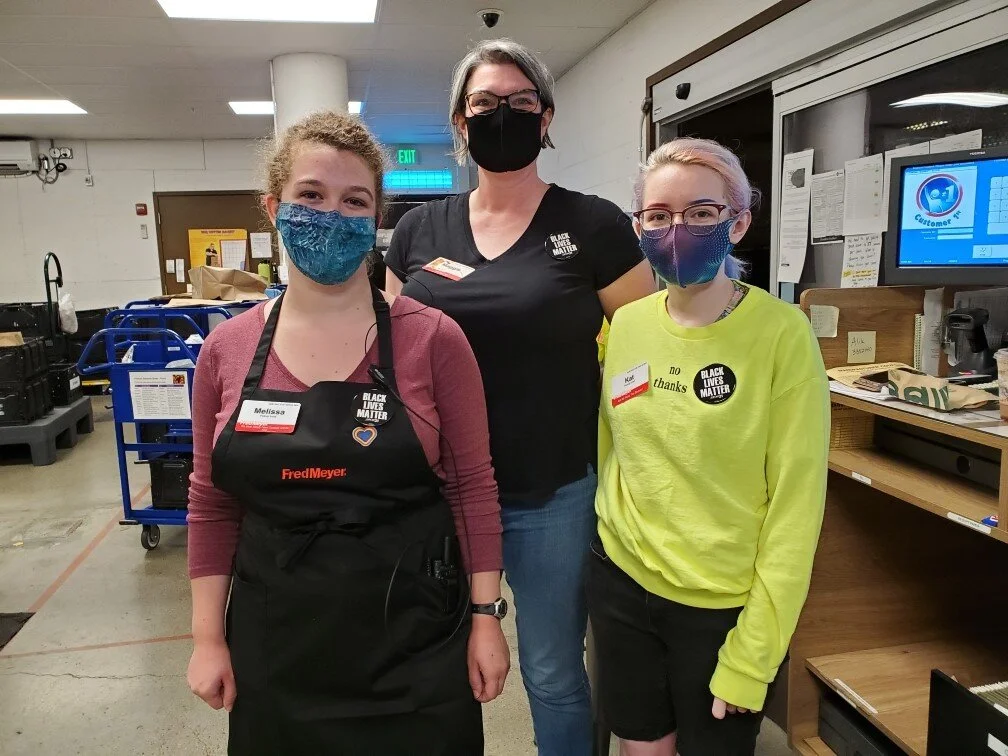
Grocery Store Workers and Community Leaders Condemn Fred Meyer and QFC Ban on Black Lives Matter Insignia 

For Immediate release: Tuesday, September 22, 2020 
Contact:  Tom Geiger, UFCW 21, 206-604-3421

Grocery Store Workers and Community Leaders Condemn Fred Meyer and QFC Ban on Black Lives Matter Insignia 

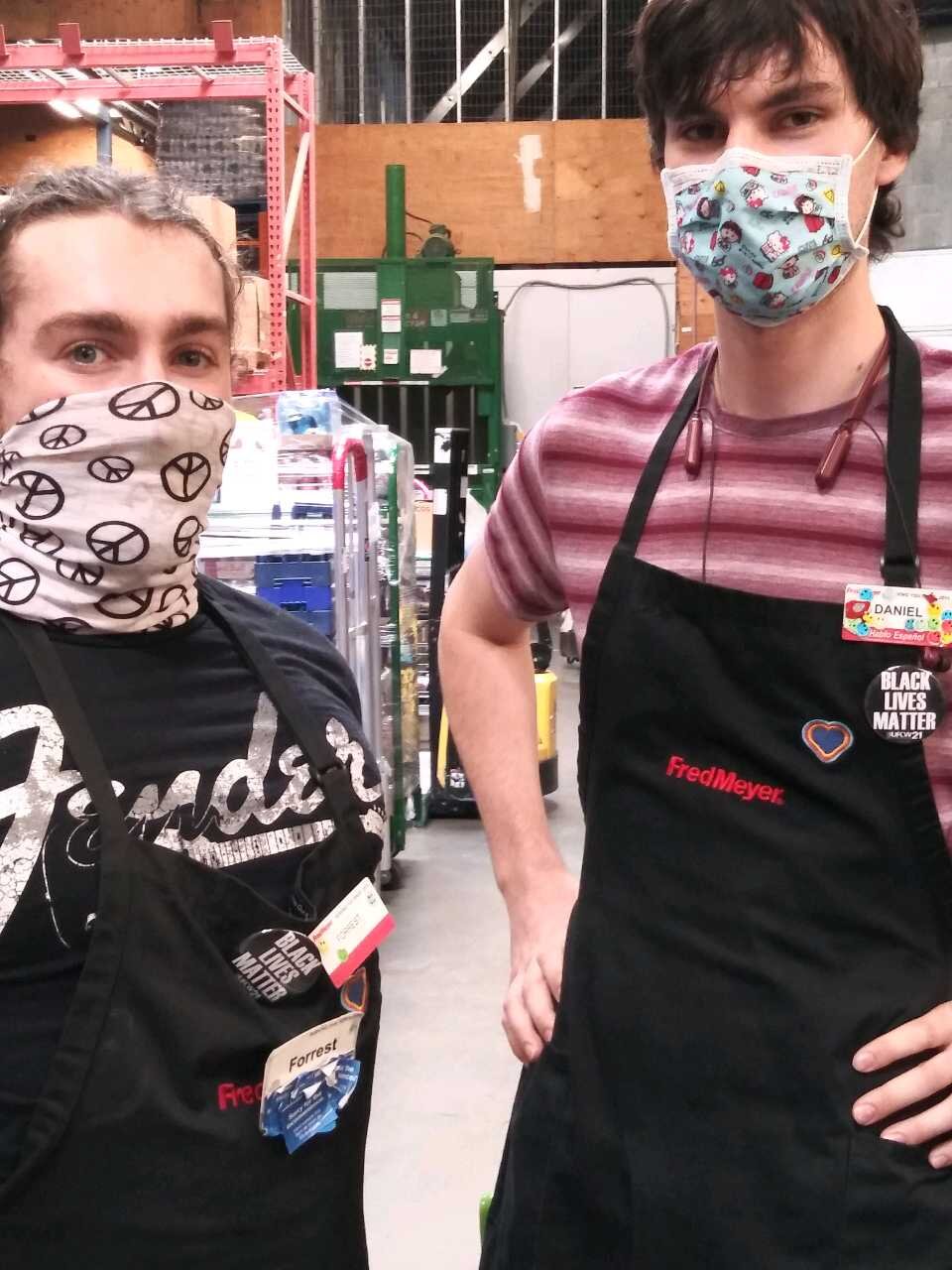
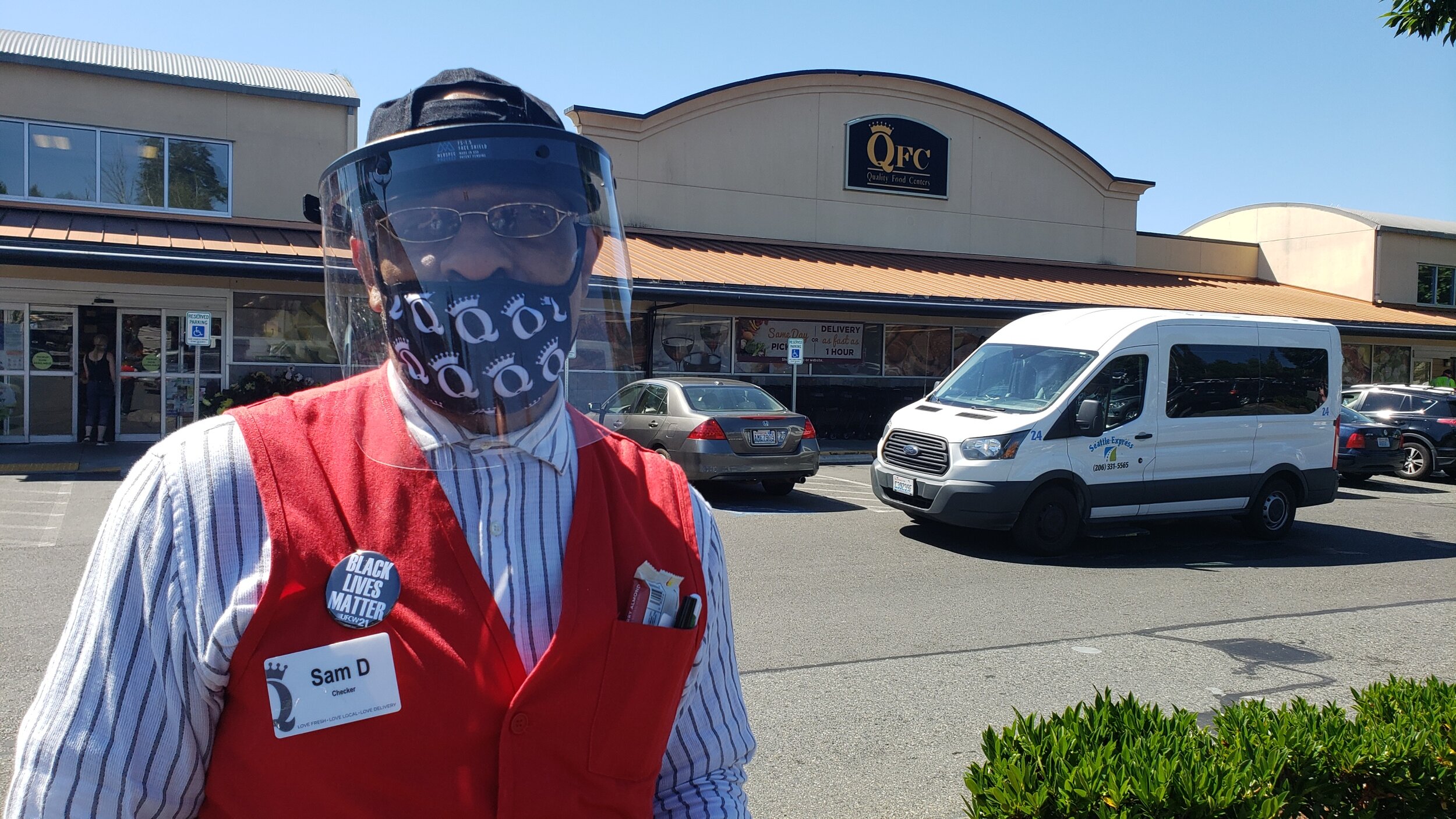
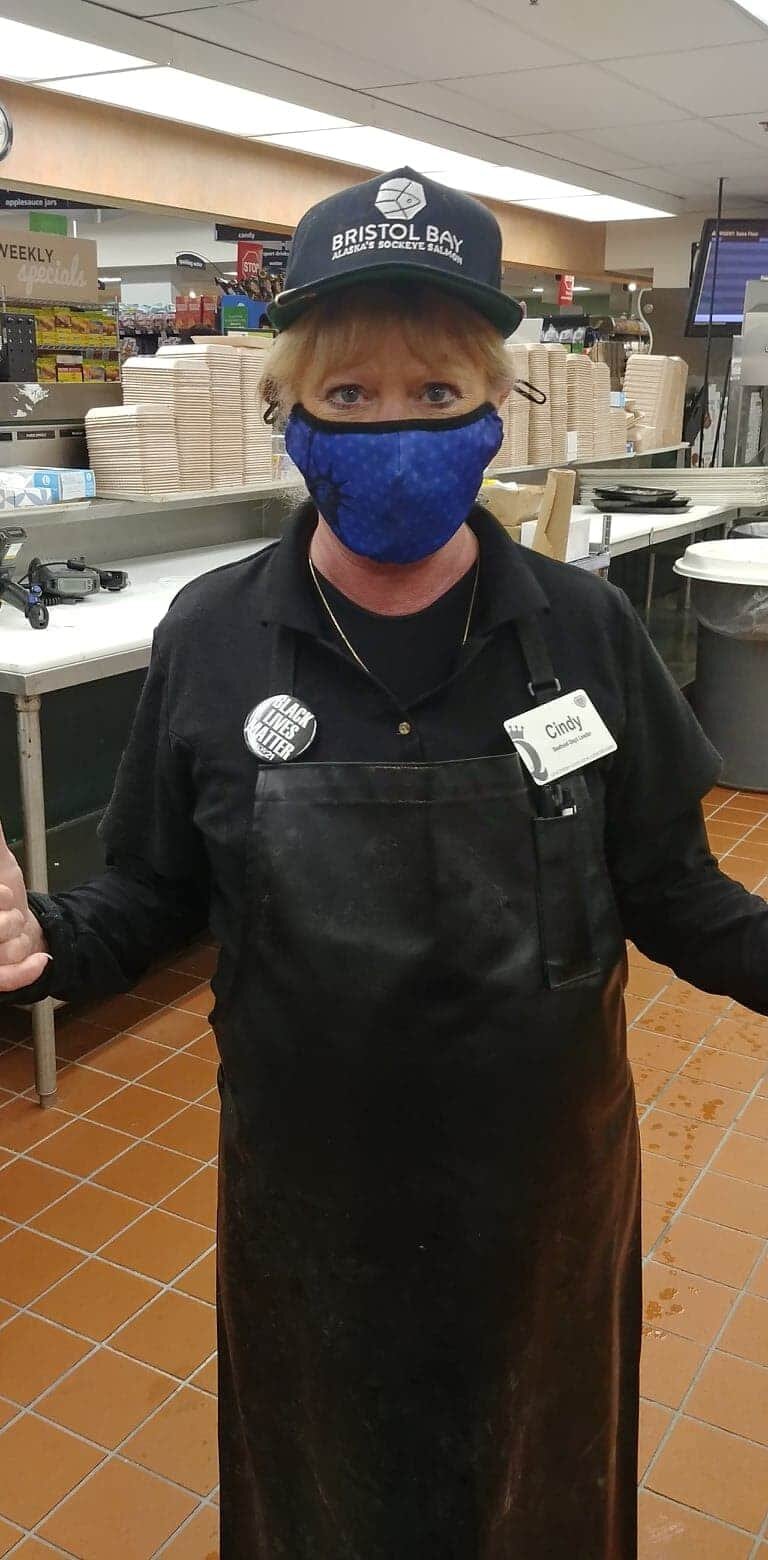
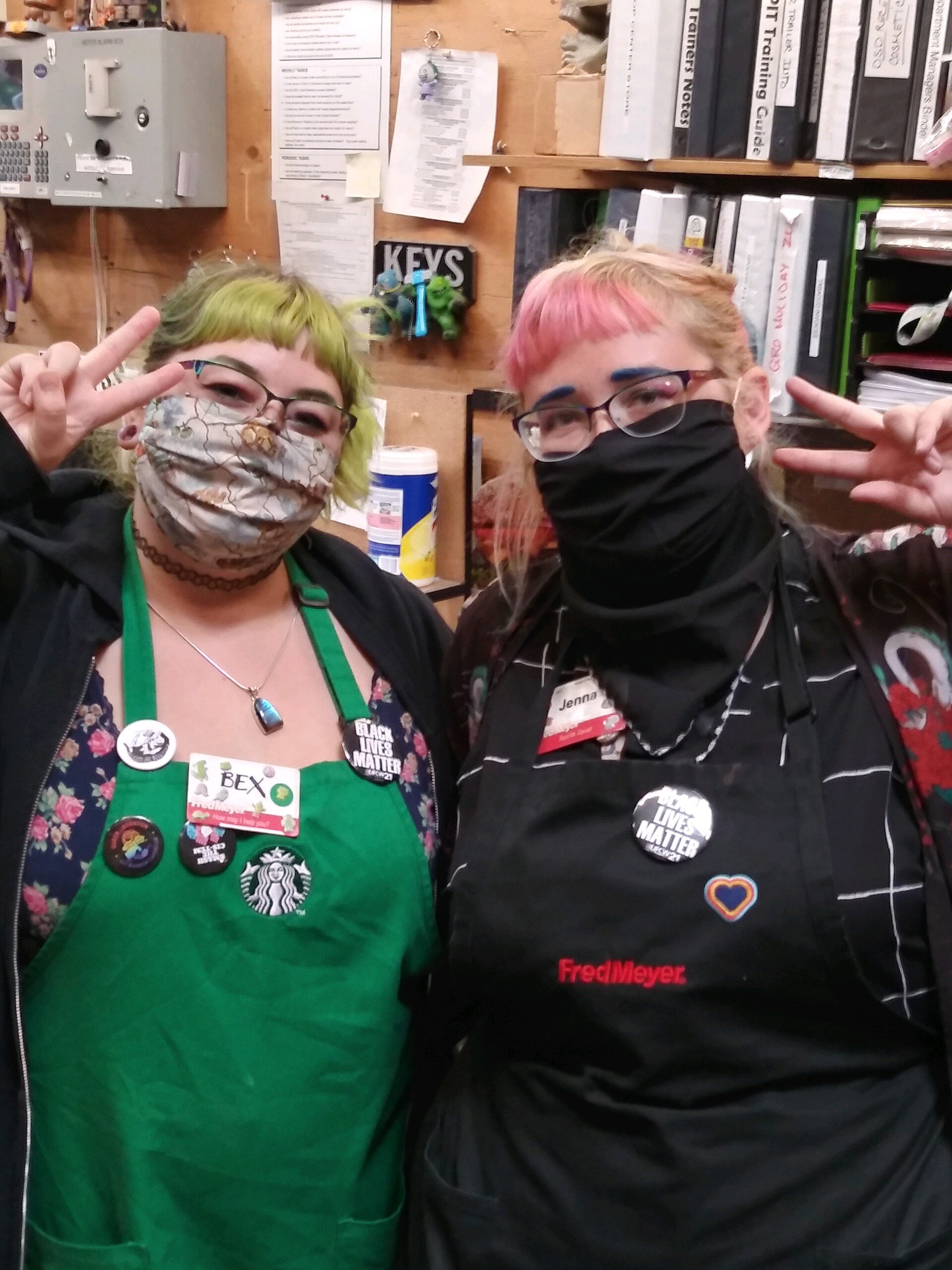
Puget Sound-area retail and grocery store workers, with the full backing of their union (UFCW 21), launched a campaign today calling on Kroger-owned Fred Meyer and QFC to reverse the companies’ ban on employees wearing Black Lives Matter buttons at work. 

Over recent weeks, management has begun ordering workers to remove “Black Lives Matter” buttons distributed by the UFCW 21. 

UFCW 21, the union which represents over 13,000 workers at Puget Sound-area Fred Meyer and QFC stores, says the ban violates workers’ rights under the companies’ union contracts and federal labor law. 

This morning, after weeks of attempts to resolve the problem internally, UFCW 21 filed formal grievances with the companies, as well as an unfair labor practice charge under federal labor law.  

UFCW 21 and community leaders are also calling on supporters to sign an online petition to the companies (see: tinyurl.com/BLMatKroger). 

Everett Fred Meyer worker Shawntia Cunningham, who is Black, explained why she is fighting for her right to wear the button: “I get pulled over by cops for having a nice car to the point that my husband, who is white, has to drive so I can just feel safe. I have been called the ‘N’ word by customers at my store a few times. I need this company to respect us as human beings and to respect our rights as workers. I need Fred Meyer and QFC and all Kroger to see that Black lives really do matter.” 

UFCW 21 President Faye Guenther said: “Systemic racism is real and it negatively impacts thousands of our members on the job and in the community. We are proud of our members who are standing up to say ‘Black Lives Matter’ and we will support their right to do so with every tool available to us.” 

The campaign is drawing support from area labor and civil rights leaders. Gabriel Prawl, Sr., A. Philip Randolph Institute (APRI) Seattle Chapter President, today called on Fred Meyer and QFC to reconsider the ban on Black Lives Matter and meet with Black workers and community leaders to address “ongoing racist issues in the retail environment.” 

April Sims, Secretary Treasurer of the Washington State Labor Council, AFL-CIO offered full support: “Solidarity among working people is the foundation of the labor movement, and these workers are living that commitment by wearing Black Lives Matter buttons. These brave workers are backed by the 550,000-person strong labor movement of Washington state, and we call on these companies to reverse their decision to prioritize the feelings of racists over the humanity of their Black and Brown employees and customers.” 

September 14 Telephone Town Hall Call with Governor Inslee

Web article title-Sept 14 TTH with Gov Inslee.jpg

Join us for a live telephone town hall call with members from every industry this Monday, September 14, at 6:30 pm. Union leadership will be joined by bargainers and union Reps to help answer questions from Members around workplace safety. Governor Jay Inslee will also join us at the beginning of the call to discuss issues that affect working people, safety concerns, and the State’s response to the COVID pandemic.

Expect a call between 6:30-6:40 to automatically join this call. If your phone number is not up to date with the union or you do not receive the call you can join by dialing 888-652-0381 and using the meeting ID: 5265

Wildfire Information for Workers

People across the West Coast are being forced to flee their homes due to encroaching wildfires. We have begun receiving requests from UFCW locals and other unions for any help and support we can offer, and we know UFCW 21 members may need support like this as well. Evacuating safely is a life or death issue. While respecting the risks of traveling and congregating during the COVID pandemic, we would like to offer whatever support or emergency shelter we can to our union family and any emergency evacuees. Mutual aid is a part of standing together in solidarity.

If you would be willing to host a person or family evacuating a wildfire area, whether in your home or outdoor area (parking space for an RV, space in your yard for a pet or farm animal), please fill out the form below to offer up your space.

Sign Up to Host Evacuees

If you are expecting to be evacuated and looking for a place to stay, whether you need a couch to sleep on, a place to park an RV, or you are evacuating pets and/or farm animals, fill out the short form below and we will be in touch with you if we can match you with someone offering shelter.

Request a place to stay

OTHER SMOKE AND FIRE INFORMATION

If your workplace is closed due to smoke or wildfire:

  • Please contact your Union Rep or the Rep of the Day line so they know about the situation and can help problem-solve.

  • If appropriate, your employer should allow you to pick up hours at another work location that is safe. If management refuses to make this option available to you, contact your Union Rep for assistance with negotiating a good arrangement.

SMOKE:

WILDFIRE:

From the DNR:

“Local emergency management offices, such as sheriff departments or local fire districts, order and communicate evacuations when needed and other emergency activities outside of the work to combat wildfire. If you find yourself in a wildfire emergency, always follow the directions of public safety personnel. In an evacuation, use the "P's of Preparedness" to focus your efforts.”

  • PEOPLE: People and, if safely possible, pets and other animals/ livestock

  • PERSONAL NEEDS: Personal needs—such as clothes, food, water, first aid kit, cash, phones, and chargers— and items for people with disabilities and others with access and/or functional needs, such as older adults, children, and those with Limited English Proficiency

  • PRICELESS ITEMS: Priceless items, including pictures, irreplaceable mementos, and other valuables

  • PRESCRIPTIONS: Prescriptions, with dosages; medicines; medical equipment; batteries or power cords; eyeglasses; and hearing aids

  • PAPERS: Papers, including important documents (hard copies and/or electronic copies saved on external hard drives or portable thumb drives)

Updates on August COVID-19 Outbreak for CHI Harrison / St Michael Members

UFCW 21 has been tracking the COVID-19 outbreak at CHI Harrison/St Michael very closely. The hospital says they learned of the first case and notified Kitsap County Health Department on August 4. The outbreak was not made public until August 21.

This week we had an emergency online meeting with hospital workers to discuss the outbreak, our demands from CHI, and our next steps. We talked in the meeting about a way for workers to report our experiences before and during this outbreak, and there was a lot of interest in a meeting with state officials to report issues directly to relevant agencies.

LISTENING SESSION WITH STATE HEALTH & LABOR OFFICIALS & GOVERNORS OFFICE

MONDAY AUGUST 31

7:30 PM

ONLINE MEETING

Register for Monday's meeting

We immediately scheduled a listening session meeting with top officials at all relevant state agencies. This is an online meeting over Zoom and all Harrison/St Michael workers are invited. We will be joined by officials from:

  • WA State Dept. of Health

  • Kitsap County Public Health

  • Labor & Industries

  • Office of the Governor

You will have a chance in this meeting to ask questions, report safety concerns, and let them know what is really happening on the ground. These agencies want to hear from you about your experiences and what you need. Please register as soon as possible, and share this important opportunity with your coworkers.


We also created a COVID outbreak safety survey and reporting tool. Members said they would appreciate a place to share experience with testing, exposure, notification, safety protocols, PPE, and other issues surrounding this outbreak. That survey is here:

Take the Survey

We encourage all Harrison/St Michael workers to spend 5 - 10 minutes this week to go through these questions and help us track as much information as possible about this outbreak and your safety. There is an option to upload pictures or documents in that survey as well, and a place you can request support if you are in quarantine and would like to be connected to any union or community support. Other members and our community across Kitsap is reaching out to ask how they can help support you at this time.


NOTES FROM OUR EMERGENCY MEETING

Our current demands for CHI:

  • Rapid testing for all workers

  • Complying with our existing agreement for 8-hour notification of any exposure

  • Paid administrative leave during the full length of any quarantine and while waiting for test results

  • Adequate PPE for all workers

  • Maintaining safe staffing levels even during this outbreak

  • Hazard pay

Existing right to paid leave: The first piece of our existing agreement with CHI says:

“A nurse or healthcare worker who the Employer does not permit to work due to exposure to Covid-19 disease while at work shall be placed in paid leave status during any required quarantine period. Paid leave status may be a combination of L&I Workers Compensation and employer paid administrative leave. The combination of which will ensure the employee will experience no loss of pay or accrued time off until such time as the Employer permits the employee to return to work. An employer representative will be available to assist employee with coordination of federal, state and employer benefits as may be applicable.”

The state has ruled that there is an automatic presumption that if a health care worker acquires COVID, it was acquired at work and you are eligible for workers comp. If you have any questions or issues with paid leave during this time, please contact your Union Rep as soon as possible.

Community support: Fellow UFCW 21 members and the larger Kitsap community are springing into action and asking what they can do to help, especially for workers who are in quarantine. We will be organizing whatever support workers need, be it meals, wellness checks, financial support, or anything else, and encourage all Harrison/St Michael workers to contact your Union Rep for whatever you or coworkers need so we can connect you with your community support.

Union actions: We are planning for public actions that are safe but can put pressure on Harrison/St Michael management to meet our demands, keep workers and patients safe, and prevent the next outbreak crisis. We will be updating everyone as these plans solidify, but if you are interested in participating or have ideas for safe actions that make a point, please connect with your Shop Steward or Union Rep.

Ongoing safety issues: We received many helpful and specific reports of safety issues and workplace concerns during the emergency meeting. We will be addressing these individually and collectively in the coming days. Examples of issues discussed include: the safety of floating right now; worries about the upcoming flu season; inadequate PPE supplies, training, and fit-testing; short staffing in many departments including EVS; nurses being asked to clean COVID rooms; special issues facing procedural care staff, cath lab, and high-risk workers; problems with testing and notification; concern around new CDC guidelines; and much more.

As always, we encourage you to report safety concerns to your Union Rep, or to use our COVID safety report email:

safetyreport@ufcw21.org


PRESS COVERAGE OF HARRISON/ST MICHAEL WORKERS SPEAKING OUT

On Tuesday August 25, we held a press conference responding to CHI’s public statements that they are handling this outbreak as well as possible, that they notified everyone involved in a timely way, and that their PPE supplies now and throughout the COVID pandemic have been totally adequate.

You can watch the full press conference at this link

And find some of the press coverage below:

National Week of Action for Hazard Pay for Essential Workers

When the COVID-19 outbreak hit, our members across industries felt it immediately—especially in frontline industries like health care and grocery stores.

We continue to believe that all essential workers deserve hazard pay during this pandemic.

UFCW has been advocating for employer-paid hazard pay as well as federal support for essential workers throughout this pandemic. Hazard pay is intended to compensate people for hazardous work duties, and all essential workers have had elevated risk added to their work lives during this crisis. We also believe many workers have new job duties related to sanitizing, infection control, protective equipment, chemical use, and handling ever-evolving public health recommendations and government mandates that change nearly everything we do. These new duties and the reminder of the centrality of our work deserves recognition that goes well beyond thank-you commercials.

After workers spoke up about what we were facing on the job and started organizing for hazard pay, many grocery employers started paying it in various forms, most commonly $2/hour in extra wages. “We recognize that this crisis is far from over,” Kroger CEO Rodney McMullen wrote to workers in mid-April. “After reflecting on feedback from you, we want to further acknowledge you for your hard work to date as well as the work yet to come.” But by mid-May, Kroger had cut hazard pay, and in mid-June Safeway/Albertsons followed suit. Other smaller local chains have ended hazard pay or never started it in the first place. And health care workers facing daily exposure to COVID patients have been demanding hazard pay from early on in this once-in-a-century pandemic, with very little action from health care employers.

We know this crisis is still far from over. This summer we’ve started giving employers more of the kind of “feedback” that really moves corporate offices—union grievances, public pressure, and essential workers and our community coming together to say enough is enough.


NATIONAL WEEK OF ACTION FOR HAZARD PAY

UFCW essential workers across the country are taking action next week to stand up for hazard pay. You can participate in this week of action!

Below, click the button to record a video message explaining why hazard pay is important to you, and what it’s like working through a pandemic. Whether it’s cracked skin and repetitive stress injuries from constant sanitizing and disinfecting, working in health care without adequate PPE, or representing an industry that hasn’t been in the news as much but is still essential—laundries, food processing, cannabis, retail, etc! Why do we need hazard pay? Let’s tell the public:

RECORD YOUR VIDEO

If you’d like to participate further in the national week of action for hazard pay, contact your Union Rep.


HAZARD PAY GRIEVANCES FILED

In July, UFCW 21 filed grievances over Fred Meyer, QFC, Albertsons, Safeway, Haggen, and PCC’s cutting of our hazard pay. Here’s an excerpt of what we said in our grievance:

As you know, the Employer paid Hazard or Appreciation pay to bargaining unit employees for at least two reasons. First, it recognized Local 21 members have been working in the stores under constant threat of exposure to the deadly COVID-19 virus. Second, the Employer relies on Local 21 members to perform additional and/or different job functions to allow customers to continue shopping uninterrupted during pandemic conditions.

Both conditions mentioned above continue to persist today. Nevertheless, the Employer unilaterally decided to eliminate or modify the Hazard/Appreciation pay. In doing so, Local 21 believes the Employer has violated numerous terms of the parties' labor agreements, including, but not limited to the Recognition, Wage classification provisions and Appendices, and Just Cause.

In the coming weeks there will be plenty of opportunities to support this grievance and take action to show employers that we are all paying close attention to their next steps and we are not taking no for an answer.